| Course | Credits | Grade | |
|---|---|---|---|
Indian letter grade and marks-to-CGPA reference
| Letter | Marks % | 10-pt CGPA | 4.0 GPA* |
|---|---|---|---|
| O (Outstanding) | 90 to 100 | 10 | 4.0 |
| A+ | 80 to 89 | 9 | 3.6 |
| A | 70 to 79 | 8 | 3.2 |
| B+ | 60 to 69 | 7 | 2.8 |
| B | 50 to 59 | 6 | 2.4 |
| C | 40 to 49 | 5 | 2.0 |
| P (Pass) | 33 to 39 | 4 | 1.6 |
| F (Fail) | Below 33 | 0 | 0.0 |
* 4.0 GPA = (CGPA / 10) x 4 (linear WES-equivalent estimate). Source: standard UGC and AICTE 10-point CGPA scale used at most Indian universities. CBSE Board uses A1 / A2 / B1 / B2 / C1 / C2 / D / E1 / E2 letter codes for Class 10 and 12 results; the bands match the marks shown here. Specific universities may shift breakpoints; for institution-specific tables, see the university directory below.
Uni Grade Calculator: How the Calculation of Grades Works in India
This Indian GPA calculator runs the standard weighted-average GPA formula across the four common scales used at Indian universities: the 10-point CGPA scale (UGC and AICTE standard at most universities, the default mode), the 4.0 GPA scale (used when applying to US graduate schools), the 4.33 scale (extended A+ range used at some private institutions and for international applications), and the percentage scale (CBSE Board Class 10 and 12 results, percentage-only marksheets). Toggle a scale and the grade input changes to match: a letter-grade dropdown for the 10-point, 4.0, and 4.33 scales (using the standard Indian letter codes O / A+ / A / B+ / B / C / P / F on the 10-point scale, and the standard US codes A+ through F on the 4.0 / 4.33 scales); a marks percentage input for the percentage scale. The institution selector beneath the scale toggle controls how the calculator converts between CGPA and percentage; CBSE x 9.5 is the school-board default, while UGC, Anna University, and Mumbai / VTU engineering use slightly different formulas covered below.
Indian students arrive at this calculator from many search routes: "Indian GPA calculator", "GPA calculator India", "uni grades calculator", "grade calculator uni", "exam percentage calculator", "marksheet percentage calculator", "btech percentage calculator", "result percentage calculator", "average grade calculator", "grade weight calculator", "grade marks", or simply "calculation of grades". All of these refer to the same underlying math at the subject and program level. The calculator above handles both per-subject grade calculation (enter individual subject marks in percentage mode) and cumulative CGPA across multiple semesters (enter every course with credits across modes), so a single tool answers the full grade-to-CGPA-to-percentage workflow that Indian universities use end to end.
Below the calculator, this page covers the four GPA scales used across India, the institution-specific CGPA-to-percentage formulas, subject-level grade calculation from marks, the CBSE Board Class 10 and 12 grading bands, the difference between SGPA, CGPA, and GPA on Indian transcripts, the four most-searched Indian university GPA calculators (with links to dedicated spokes), how to convert an Indian CGPA to the US 4.0 scale, and what counts as a competitive GPA for graduate admissions in India and abroad. The Frequently Asked Questions answer the most common Indian GPA, CGPA, and grade questions captured from People-Also-Ask boxes on Google India.
Indian Grading System: GPA Scales Used at Universities
Indian universities use four GPA scales depending on the institution, the program level, and the application context. Knowing which scale your university uses determines which letter-to-points conversion the calculator should apply:
- 10-point CGPA scale (most common). The UGC and AICTE-recommended scale used at most Indian universities and engineering colleges. The standard letter mapping is O (Outstanding) = 10, A+ = 9, A = 8, B+ = 7, B = 6, C = 5, P (Pass) = 4, F (Fail) = 0. Some universities use slightly different lettering (S = 10 in place of O at a few private institutions, E = 4 in place of P) but the underlying point values match. The cumulative report on the official transcript is the CGPA: a credit-weighted average of grade points across every semester completed.
- 4.0 scale (US conversion). The standard US graduate school scale: A = 4.0, A- = 3.7, B+ = 3.3, B = 3.0, B- = 2.7, C+ = 2.3, C = 2.0, C- = 1.7, D = 1.0, F = 0.0. Indian transcripts rarely report on this scale natively; students typically convert using the linear formula GPA = (CGPA / 10) x 4 when applying to US universities, or commission a course-by-course evaluation from WES (World Education Services).
- 4.33 scale (extended). An A+ at 4.33 (sometimes reported as 4.30 or 4.3) used at a small number of Indian institutions for honors-track or international-application transcripts. The 4.33 scale rewards consistent A+ work; a student with all A+ grades earns 4.33 cumulative GPA where the same student on the 4.0 scale would earn 4.0. Most US graduate schools accept the 4.33 value as-is and treat it as equivalent to a 4.0 with credit for A+ work.
- Percentage scale (CBSE Board, marksheets). Used for CBSE and ICSE Class 10 and Class 12 results, ICSE university-level transcripts, and any Indian university that issues a percentage-only marksheet. Each course is reported as a numeric percent (0 to 100); the cumulative percentage is the credit-weighted average. Conversion to a CGPA happens at admissions time using the institution's formula (CBSE Class 10 uses Percentage = CGPA x 9.5, so CGPA = Percentage / 9.5).
How GPA Is Calculated in India
The GPA calculation formula is the same across all Indian universities; only the letter-to-points table changes by scale. The standard weighted-average formula:
- Grade Points = numeric value of the letter grade on the 10-point scale (O = 10, A+ = 9, A = 8, B+ = 7, B = 6, C = 5, P = 4, F = 0)
- Credits = the credit hours the course is worth on your transcript
- Σ = the sum across every course in the period (semester for SGPA, all semesters to date for CGPA)
Two implementation details affect Indian GPA calculations specifically. First, credit-hour weighting matters. Indian engineering programs typically run 3-credit theory courses paired with 1 or 2-credit lab courses; a strong grade in a 4-credit course pulls the CGPA up more than the same grade in a 1-credit lab. The calculator above respects credit weighting on every row. Second, repeated and audit courses follow your university's replacement rule. AICTE-regulated institutions usually let the higher attempt replace the earlier one in the CGPA; UGC universities often average both attempts; some private universities require the higher of two attempts. Audited and pass-fail courses typically do not count toward CGPA but do count toward graduation credits. Enter only the courses that count for CGPA; transfer credits and audited courses should be left out.
Subject Grade and Marks Percentage Calculation in Indian Schools and Colleges
Before the CGPA stage, every Indian transcript starts with subject-level grades and marks. The marks-to-grade-point mapping is what the term "calculation of grades" refers to in most Indian school and college contexts. The standard 10-point conversion: 90 to 100 percent earns O (10 grade points), 80 to 89 percent earns A+ (9), 70 to 79 percent earns A (8), 60 to 69 percent earns B+ (7), 50 to 59 percent earns B (6), 40 to 49 percent earns C (5), 33 to 39 percent earns P (4), and below 33 percent fails (F, 0). A B grade in this band sits between 50 and 59 percent; a C grade sits between 40 and 49 percent. The grade-point reference table inside the calculator above lists all eight bands with the matching 4.0 GPA equivalents.
Subject Exam Result Percentage Calculator (Marks to Letter)
To compute a single subject's grade from its marks, switch the calculator to the percentage scale, enter the subject name and the marks earned out of 100 (credits = 1 if you only want a single-subject reading), and read the matching letter grade from the result panel. To average multiple subject marks into a class average (the "exam percentage calculator", "marksheet percentage calculator", and "result percentage calculator" pattern), enter every subject as its own row with credits = 1 and the marks percentage; the calculator returns the unweighted average percentage across subjects, equivalent to dividing the total of marks by the total of maximum marks. For credit-weighted averages where some subjects carry more weight than others (engineering programs, semester-end averages with theory + lab credits), enter the actual credits per subject and the calculator applies the right weighting automatically.
Average Grade Calculator and Grade Tracker for the Semester
A semester-long grade tracker is just the cumulative running version of the average grade calculator: add each new test, internal assessment, or final exam as a row and watch the running grade update. The B grade percentage band (50 to 59 percent) and the C grade band (40 to 49 percent) are the two most-asked bands in Indian school searches because they sit at the academic-warning thresholds for many programs (most engineering colleges require a B in major-related courses, and a C in any subject typically requires a re-exam at most state universities). For category-weighted assignments where teachers assign different weights to assignments, midterms, and finals (the "grade weight calculator" pattern), use the weighted grade calculator, which applies the weighted-average formula across the same input modes.
How to Calculate Grade Point from Marks (Step by Step)
Step 1: convert each subject's marks to a grade point on the 10-point scale using the band table above. Step 2: multiply each subject's grade point by its credits. Step 3: sum the credit-weighted grade points across all subjects in the period. Step 4: divide by the total credits to get the grade point average for that period (SGPA for one semester, CGPA across all semesters). Step 5 (optional): convert the resulting CGPA to a percentage using your institution's formula (CBSE x 9.5, UGC (CGPA - 0.75) x 10, Anna CGPA x 10, Mumbai or VTU (CGPA - 0.75) x 10). The calculator above runs all five steps live as you type; the Excel formula equivalent is =SUMPRODUCT(grade_points, credits) / SUM(credits) for the GPA part, then a single multiplication or subtraction to apply the institution's percentage formula.
Convert CGPA to Percentage (CBSE, UGC, Anna, Mumbai, VTU)
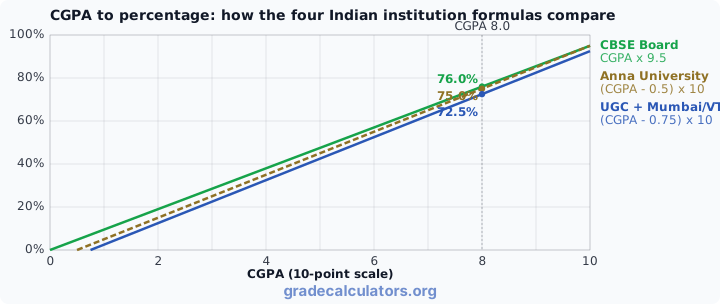
Different Indian institutions use different CGPA-to-percentage formulas. The institution selector in the calculator above applies the right formula live; the chart below shows how the four formulas diverge across the 10-point CGPA scale, and the table that follows summarizes them with worked values.
| Institution | Formula | 9.0 CGPA gives | 8.0 CGPA gives | 7.5 CGPA gives |
|---|---|---|---|---|
| CBSE Board (Class 10, 12) | Percentage = CGPA x 9.5 | 85.5% | 76.0% | 71.3% |
| UGC default (most universities) | Percentage = (CGPA - 0.75) x 10 | 82.5% | 72.5% | 67.5% |
| Anna University (Tamil Nadu) | Percentage = CGPA x 10 | 90.0% | 80.0% | 75.0% |
| Mumbai University (engineering) | Percentage = (CGPA - 0.75) x 10 | 82.5% | 72.5% | 67.5% |
| VTU (Karnataka, engineering) | Percentage = (CGPA - 0.75) x 10 | 82.5% | 72.5% | 67.5% |
Notable institution-specific deviations: CBSE publishes the x 9.5 formula in its official notification for Class 10 and Class 12 results; UGC recommends (CGPA - 0.75) x 10 for university CGPA with the caveat that universities may publish their own version; Anna University publishes its own CGPA x 10 formula in its academic regulations (Clause 16, unchanged across Regulation 2013, 2017, and 2021), higher than the generic UGC discount; Mumbai University engineering and VTU match the UGC formula. Always confirm with your registrar because a few universities publish course-specific or program-specific deviations from the standard formula.
CBSE Board Grading (Class 10 and Class 12)
The Central Board of Secondary Education (CBSE) reports Class 10 and Class 12 results using a 10-point CGPA scale paired with a letter band. The bands are positional (top 1/8th of the passed cohort gets A1, next 1/8th gets A2, and so on), so the percentage cutoffs shift slightly each exam cycle, but the long-term mapping is:
| CBSE Letter | Marks Range | Grade Point | Tier |
|---|---|---|---|
| A1 | 91 to 100 | 10 | Top performance |
| A2 | 81 to 90 | 9 | Excellent |
| B1 | 71 to 80 | 8 | Very good |
| B2 | 61 to 70 | 7 | Good |
| C1 | 51 to 60 | 6 | Above average |
| C2 | 41 to 50 | 5 | Average |
| D | 33 to 40 | 4 | Pass |
| E1 | 21 to 32 | 0 | Improvement needed |
| E2 | 0 to 20 | 0 | Improvement needed |
The CBSE 10th class percentage calculator and 10 class percentage calculator queries refer to this same conversion; multiply the average grade point by 9.5 to get the CBSE percentage. A Class 10 student with five A1 grades (10 each) and one A2 grade (9) has an average grade point of (5 x 10 + 1 x 9) / 6 = 9.83, which converts to 9.83 x 9.5 = 93.4 percent. ICSE Board (Council for the Indian School Certificate Examinations) reports percentages directly without an intermediate CGPA, so the CBSE formula does not apply to ICSE marksheets. State boards (Maharashtra HSC, Tamil Nadu HSC, Karnataka PUC, etc.) typically report percentages directly; check the relevant state board's official notification for any CGPA mapping.
Indian University GPA Calculators
Each Indian university has its own grading scale, percentage-to-CGPA conversion, and academic standing thresholds. The institution-specific calculators below cover four of the most-searched Indian universities, each with its exact grade letters and percentage formula. The Indian GPA calculator above also works for any of them by selecting the right scale and institution formula.
- Vellore Institute of Technology VIT 10-point CGPA + S grade (private)
- SRM Institute of Science and Technology SRM 10-point CGPA
- Anna University Anna 10-point CGPA, CGPA x 10 percentage
- Indira Gandhi National Open University IGNOU 10-point grade-card system
Other major Indian universities (Indira Gandhi National Open University, the IIT system, NIT system, Delhi University, JNU, Mumbai University, Pune University, Hyderabad Central University, JNTU Hyderabad, BITS Pilani, Manipal Academy of Higher Education) follow the 10-point CGPA scale with their own published formula deviations. The calculator above handles the common cases; select the closest institution preset (UGC default for most central and state universities, Anna for Tamil Nadu state-affiliated colleges, Mumbai / VTU for engineering colleges across western India and Karnataka).
How to Convert an Indian CGPA to the US 4.0 Scale
Indian students applying to US graduate schools, professional programs (MS, PhD, MBA), or US universities for transfer admission typically need to report their CGPA on the US 4.0 scale. The conversion depends on which Indian scale you started from:
- From the 10-point CGPA. Use the linear formula GPA = (CGPA / 10) x 4. A 9.0 CGPA converts to 3.6 on the US 4.0 scale; an 8.0 CGPA converts to 3.2; a 7.5 CGPA converts to 3.0. Yocket, Leap Scholar, and most Indian study-abroad services use this formula. The calculator above shows the equivalent automatically when you toggle the 10-point CGPA scale.
- From a percentage transcript. First convert percentage to a 10-point CGPA using your institution formula (Percentage / 9.5 for CBSE; Percentage / 10 + 0.75 for UGC default; Percentage / 10 for Anna University), then apply the linear formula above to get the US 4.0 GPA.
- From a 4.33 scale transcript. Most US graduate schools accept the 4.33 value as-is. A small number of US programs strictly cap GPA at 4.0; in those cases, cap your reported GPA at 4.0 (an applicant with 4.20 reports 4.0). The 4.33 scale was designed to be transparent across both systems, so most US admissions committees understand it without conversion.
- For competitive applications, get a WES evaluation. WES (World Education Services) converts your Indian transcript course-by-course to the US 4.0 scale using their published India grade scale, which most US graduate schools accept as the canonical conversion. The cost is approximately 200 USD for a full course-by-course evaluation; LSAC handles its own conversion for US law school applications, AACOMAS for osteopathic medical school, and AADSAS for dental school.
For a narrower tool that handles only the 10-point to 4-point conversion (no course rows, no institution toggle), use the 10-point to 4-point GPA converter. For a multi-country CGPA hub that includes Pakistan HEC, Bangladesh, and Malaysia formulas alongside India, see the CGPA calculator.
What Counts as a Good CGPA in India
Different Indian post-graduate programs and Indian study-abroad applications weight CGPA differently. Knowing the typical thresholds helps you target schools where your CGPA is competitive:
- Indian master's programs (research-thesis): IITs, NITs, and central universities typically require a minimum CGPA of 6.5 to 7.0 on the 10-point scale (or 60 to 65 percent on percentage transcripts) for admission, with stronger candidates around 8.0 to 9.0. Top IIT M.Tech / M.Sc programs expect 8.5+ paired with strong GATE scores.
- Indian master's programs (course-based MBA, MCA): IIM admissions typically expect a CGPA of 7.5 to 9.0 on the 10-point scale paired with a competitive CAT score (95th percentile or above for top IIMs). Tier-2 MBA programs accept lower CGPAs with relevant work experience.
- US graduate school admissions (top tier): MIT, Stanford, CMU, Berkeley, Princeton typically expect a CGPA of 8.5 or above on the 10-point scale (3.4 to 3.5 on US 4.0), strong GRE / GMAT scores, and research or work experience.
- US graduate school admissions (mid-tier): 7.5 to 8.5 CGPA (3.0 to 3.4 on 4.0) is competitive at most state universities and respected private programs paired with a competitive GRE or GMAT.
- Job placements (Indian campus recruiting): Tier-1 IT employers (TCS, Infosys, Wipro, Accenture) typically set a 6.5 CGPA or 60 percent cutoff; product companies (Microsoft, Amazon, Google India) and consulting firms (McKinsey, BCG) typically expect 7.5+ CGPA with stronger candidates above 8.5.
First Class with Distinction is the highest undergraduate degree designation at most Indian universities; it requires a CGPA of 8.5 or above on the 10-point scale (or approximately 75 to 80 percent on percentage transcripts). First Class is 6.5 to 8.5 CGPA (60 to 75 percent), Second Class is 5.0 to 6.5 CGPA (45 to 60 percent), and Pass Class is 4.0 to 5.0 CGPA (33 to 45 percent). The calculator above flags these standings automatically based on the normalized 4.0 GPA so the interpretation is consistent across the four scales. To combine multiple semester CGPAs into a single cumulative figure (useful when applying to graduate programs that ask for a final-year or last-60-credits figure), use the cumulative GPA calculator.
This calculator estimates Indian university CGPA and GPA using the four common scales (10-point CGPA, 4.0, 4.33, percentage) and four common institution percentage formulas (CBSE, UGC, Anna University, Mumbai / VTU). Specific universities may publish their own conversion tables; verify with your registrar for official transcripts. For US graduate school applications, see World Education Services (WES) for the canonical India to US 4.0 conversion. For CBSE Board grading, see the CBSE official site; for AICTE-regulated technical programs, see AICTE; for UGC notifications on CGPA conversion, see UGC India.