Calculate your CGPA
| Course | Credits | Grade | Remove |
|---|---|---|---|
Grade reference (active scale)
Reference values reflect the most common letter-to-point mapping on each scale; some institutions adjust slightly. Verify with your registrar before submitting any official figure.
How to Calculate CGPA: The CGPA Score Calculation Formula
Calculating CGPA is the same arithmetic everywhere; only the grade scale changes. List every course on your transcript, multiply each grade's point value by its credits, sum the products to get total quality points, then divide by total credits. The CGPA calculator above runs that math live on whichever scale you select. Pakistan HEC universities, most Bangladesh private universities, and Malaysian polytechnics use the 4.0 scale. Indian UGC and CBSE-affiliated universities use the 10-point scale. Nigeria and Saudi Arabia commonly use a 5.0 scale. The arithmetic matches what our GPA calculator uses on the US 4.0 scale; the difference is the country-specific letter-to-point mapping and the percentage conversion that follows.
The CGPA Formula
- Grade Points = numeric value of the letter grade on the active scale (4.0, 5.0, or 10-point)
- Credits = the credit hours, units, or course-load value listed on your transcript
- Σ = the sum across every course on the transcript or term being averaged
Worked Example: A Five-Course Semester
Consider a Pakistani undergraduate at UMT Lahore taking five courses on the 4.0 scale. The student earns an A (4.0) in a 3-credit Calculus course, a B+ (3.3) in a 4-credit Programming course, an A- (3.7) in a 3-credit Linear Algebra course, a B (3.0) in a 3-credit Communications course, and a C+ (2.3) in a 2-credit Pakistan Studies course. Quality points: (4.0 x 3) + (3.3 x 4) + (3.7 x 3) + (3.0 x 3) + (2.3 x 2) = 12 + 13.2 + 11.1 + 9 + 4.6 = 49.9. Total credits: 15. Semester CGPA = 49.9 / 15 = 3.33. The result panel above shows the same number when you enter these courses.
What CGPA Stands For
CGPA stands for Cumulative Grade Point Average, the running average of every grade you've earned across all semesters on your academic transcript so far. The "C" distinguishes it from Semester GPA (SGPA), which only covers the current term. CGPA is the figure most universities use when deciding scholarship eligibility, academic standing, graduation honours, and admission to graduate programmes. The full form differs slightly by region; some Indian universities expand the acronym to "Cumulative Grade Point Average" while a few Pakistani institutions use "Cumulative GPA" interchangeably. The math is identical regardless of the expansion.
How CGPA Differs from Semester GPA
SGPA covers one term; CGPA covers everything to date. If you score an SGPA of 3.8 in your sixth semester after a string of weaker terms, your CGPA may still sit around 3.2 because the earlier semesters carry equal weight in the running total. Universities that print both numbers on a transcript use SGPA to assess current-term performance and CGPA for the cumulative academic record. Scholarship cutoffs and graduation honours almost always reference CGPA, not SGPA. Students working on the US 4.0 scale can run the same multi-semester math through our cumulative GPA calculator, which accepts a prior cumulative GPA and credits as a seed input. For Indian 10-point scale transcripts, the SGPA to percentage calculator converts a semester SGPA to percentage using UGC, SPPU, Anna University, and KTU formulas, and also derives CGPA from a table of semester SGPAs and credit hours.
GPA vs CGPA: What's the Difference Between GPA and CGPA
GPA and CGPA mean the same arithmetic but they're used in different academic systems. American universities print "GPA" on transcripts and rarely use the word CGPA in everyday speech, even when reporting cumulative numbers. South Asian, Malaysian, and Bangladeshi universities default to CGPA on transcripts and use GPA only when referring to a single semester. So a US transcript line that reads "Cumulative GPA: 3.45" and a Bangladeshi transcript line reading "CGPA: 3.45" describe identical figures. Students who want a combined GPA and CGPA calculator, a GPA calculator CGPA, a CGPA GPA calculator, or a CGPA calculator out of 4 can use this same widget, since the math under any of those labels is the credit-weighted average of grade points the formula above produces.
Combined GPA and CGPA Calculator: One Tool for Both Labels
Some students search for a "GPA and CGPA calculator" expecting two separate widgets, but the underlying math is identical: both compute a credit-weighted average of grade points. This page works as a unified GPA calculator CGPA tool, a CGPA GPA calculator, or simply a CGPA calculator depending on which term your university uses. Switching the scale toggle adapts the same widget to whichever convention your transcript follows.
When to Use GPA vs CGPA on Applications
Application forms specify which figure they want. US graduate-school applications typically ask for "Cumulative GPA" or simply "GPA"; submit your CGPA in either field if your home university uses CGPA terminology. Pakistani HEC scholarship forms and most Indian university admission portals ask for CGPA explicitly. When in doubt, attach the official transcript so the admissions office sees both per-semester and cumulative figures and applies their own conversion. The CGPA to GPA converter handles the 10-point to 4.0 mapping that overseas applications often require.
CGPA on the 4.0, 5.0, and 10-Point Scales
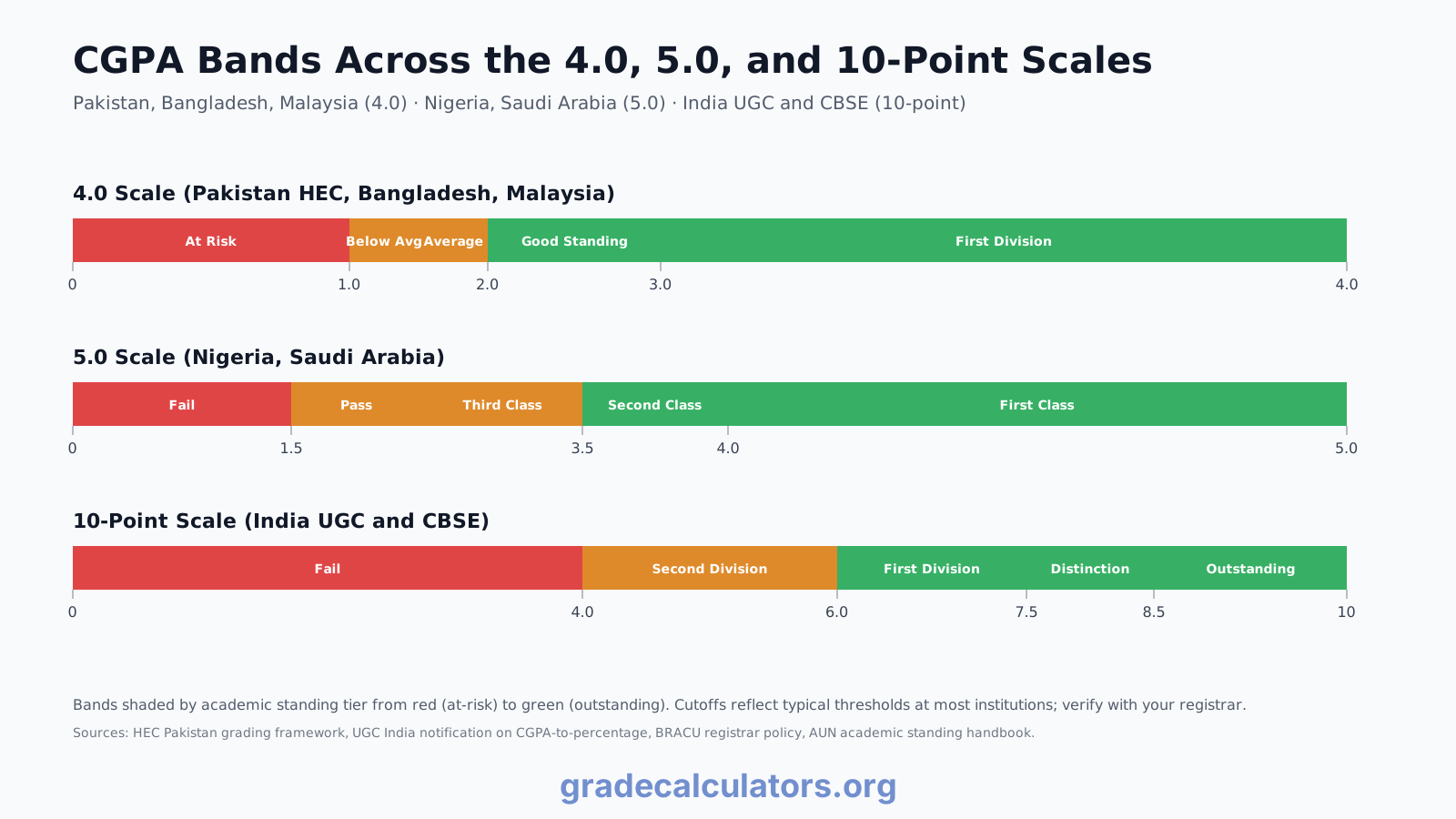
Three CGPA scales dominate worldwide. Each assigns different point values to the same letter grades, so a CGPA number is meaningful only when paired with its scale. The figure below shows where academic-standing thresholds sit on each scale.
4.0 Scale: Pakistan HEC, Bangladesh, Malaysia
The 4.0 scale assigns A = 4.0, A- = 3.7, B+ = 3.3, B = 3.0, B- = 2.7, C+ = 2.3, C = 2.0, C- = 1.7, D+ = 1.3, D = 1.0, F = 0.0. Pakistan HEC universities standardised on this scale across both public and private sectors. Bangladesh private universities like BRACU, NSU, and IUB use the same 4.0 letter mapping; the National University of Bangladesh is on a similar 4.0 with marginal letter cutoffs. Malaysian polytechnics and most public universities follow Senate-approved 4.0 grade points with cumulative thresholds at 2.0 (good standing) and 3.5 (first-class honours equivalent). DLSU and Ateneo in the Philippines also publish a 4.0 CGPA alongside their native 1.0-to-5.0 scale.
CGPA Calculator Out of 4: The Standard 4.0 Scale Quick Reference
Pages and applications often say "CGPA calculator out of 4" to mean a calculator on the standard 4.0 scale. Set the scale selector to 4.0 and the widget operates as a CGPA calculator out of 4 with letter grades A through F mapped to 4.0, 3.7, 3.3, 3.0, and so on through 0.0 for F. Both BRACU students and Pakistan HEC students looking for a CGPA score calculation on this exact mapping land here. An 8 CGPA on the 10-point scale (covered next) maps to roughly a 3.2 on the 4.0 scale via linear conversion.
10-Point Scale: India UGC and CBSE
The Indian UGC notification (2017) standardised university CGPA on a 10-point scale with eight letter grades: O (Outstanding) = 10, A+ (Excellent) = 9, A (Very Good) = 8, B+ (Good) = 7, B (Above Average) = 6, C (Average) = 5, P (Pass) = 4, F (Fail) = 0. CBSE-affiliated schools use a near-identical 10-point scale for board examinations. First-division on the 10-point scale starts at CGPA 6.0 in most universities; first-division with distinction begins at 7.5; the rank list typically requires 8.5 or above. The calculator above selects this scale automatically when you pick India CBSE or India UGC in the country selector.
Convert CGPA to Percentage
Converting CGPA to percentage is the second-most-searched action on this page after the calculation itself, because admission portals and scholarship forms in some countries ask for both. The conversion formula depends on which country and which scale you start from. The result panel above shows the converted percentage live; the rules below explain why the answer differs across institutions.
India: The CBSE x 9.5 Rule
The Central Board of Secondary Education (CBSE) publishes the CGPA-to-percentage conversion as Percentage = CGPA x 9.5 for board examinations. A 9.0 CGPA converts to 85.5%, an 8.4 CGPA to 79.8%, and a 7.0 CGPA to 66.5%. The formula is an approximation derived from the average grade-band midpoints; it's the figure CBSE itself prints on result cards alongside the CGPA. Universities that ask for a percentage equivalent on a CBSE-graded transcript accept this value as official.
India UGC: The (CGPA - 0.75) x 10 Rule
For university-level CGPA, the UGC notification recommends Percentage = (CGPA - 0.75) x 10 to convert CGPA on the 10-point scale to a percentage. A 9.0 CGPA converts to 82.5%, an 8.4 CGPA to 76.5%, and a 7.0 CGPA to 62.5%. The UGC formula is more conservative than the CBSE x 9.5 rule because it accounts for the fact that university grade distributions are typically tighter and the maximum CGPA of 10.0 is harder to achieve than CBSE's 10.0 ceiling.
Pakistan, Bangladesh, and Malaysia: Linear Conversion
Pakistan HEC universities, Bangladesh private universities, and Malaysian institutions on the 4.0 scale use a linear conversion: Percentage = (CGPA / 4.0) x 100. A 3.5 CGPA converts to 87.5%, a 3.0 CGPA to 75%, and a 2.5 CGPA to 62.5%. The conversion is approximate because the underlying letter-to-percentage mapping varies by university, but it is the standard figure Pakistani HEC and Bangladeshi private universities publish on transcripts when both numbers are required. WES and other credential evaluators usually apply their own table on top of the linear figure.
Convert CGPA to Marks: A Built-In CGPA to Marks Calculator
Some application forms ask for marks out of 100 rather than CGPA or percentage. The widget above doubles as a CGPA to marks calculator: enter your courses on any scale and the result panel emits the equivalent marks alongside the CGPA and percentage figures. To convert CGPA to marks manually, multiply the CGPA by (100 / scale-maximum). On the 4.0 scale a CGPA of 3.0 maps to 75 marks; on the 10-point scale a CGPA of 8.0 maps to 80 marks. Use this number cautiously: most universities print percentage rather than marks on official transcripts, so the marks figure is best treated as a derived approximation rather than the official record.
How CGPA Maps to Marks Across Scales
- 4.0 scale, CGPA 3.5: 87.5 marks out of 100. First-division at most Pakistan HEC and Bangladesh private universities.
- 4.0 scale, CGPA 3.0: 75 marks out of 100. Solid pass; meets the typical postgraduate admission minimum.
- 10-point scale, CGPA 8.0: 80 marks linear; 76 marks under UGC formula; 76 marks under CBSE x 9.5 minus rounding.
- 10-point scale, CGPA 6.0: 60 marks linear; first-division boundary at most Indian universities.
- 5.0 scale, CGPA 4.5: 90 marks out of 100. First-class honours at Nigerian and Saudi institutions on this scale.
CGPA Calculation by Country
Country-specific calculation rules exist because each higher-education regulator publishes its own grading framework. The differences are usually marginal in the math but matter when an admissions officer or registrar interprets your transcript.
Pakistan (HEC Universities): CGPA Calculator Pakistan
Pakistan's Higher Education Commission (HEC) recommends a uniform 4.0 CGPA scale across regulated universities. Public-sector institutions like Punjab University, NUML, and the UAF system, plus private universities including UMT Lahore, Superior University, and UCP, all publish CGPA on the 4.0 scale. HEC scholarship eligibility typically begins at 3.0 CGPA; the Quaid-e-Azam scholarship cutoff sits at 3.5. A handful of Pakistani universities use a 5.0 grade-point scale internally and convert to 4.0 only when issuing transcripts; check your official document for the printed figure.
Bangladesh (NU and Private Universities)
Bangladesh has two coexisting systems. Public universities under the National University of Bangladesh (NU) use a 4.0 letter-grade scale with first-division at 3.0 CGPA and second-division at 2.25. Private universities like BRACU, NSU, IUB, AIUB, and EWU use a near-identical 4.0 grade-point scale with letter cutoffs that sometimes vary by 1-2 percentage points at the boundary. BUET, the country's top engineering university, uses the same 4.0 scale with a stricter letter-to-percentage mapping at the upper end. The CGPA calculator above defaults to 4.0 for any Bangladesh selection.
India (UGC Universities)
Indian universities under the UGC mandate publish CGPA on the 10-point scale. The CBSE board uses the same 10-point scale for Class X and Class XII examinations, applying CGPA x 9.5 when a percentage is required. State boards in Tamil Nadu, Karnataka, and Maharashtra publish percentages directly without an intermediate CGPA. IIT and NIT engineering institutes, IIM business schools, and most central universities follow the UGC 10-point scale with first-division at 6.0, first-division with distinction at 7.5, and rank list at 8.5+ CGPA. Students asking "how to calculate CGPA in university" follow this same 10-point scale at most UGC institutions, where an 8 CGPA roughly corresponds to a 76% under the UGC formula and 76 marks per 100 under linear conversion. The CGPA score calculation is identical regardless of board or institution: weighted average of grade points by credits.
Malaysia (Polytechnic and Public Universities)
Malaysian Senate-approved CGPA frameworks use the 4.0 scale across public universities, polytechnics, and most private universities. Universiti Malaya, Universiti Putra Malaysia (UPM), Universiti Sains Malaysia (USM), and Universiti Teknologi Malaysia (UTM) all publish CGPA on the 4.0 scale with first-class honours starting at 3.67. Polytechnics under the Ministry of Education follow a similar 4.0 framework; the practical difference is the per-letter mapping at the C boundary, where some polytechnics treat 50% as the C cutoff while public universities use 55%. Verify with your registrar.
Per-University Variations: BRACU, UMT, UTSC, NUML, and CGPA Calculator Monash
Within each country, individual universities adjust the standard scale slightly. The same multi-scale tool above doubles as a BRACU CGPA calculator, UMT CGPA calculator (or "CGPA calculator UMT"), UTSC CGPA calculator, NUML CGPA calculator, Superior University CGPA calculator, CGPA calculator Monash for Australian Monash students, and a general CGPA to grade calculator for any institution on the standard 4.0 scale. Students searching specifically for "umt cgpa calculator" or "bracu cgpa calculator" can use this same widget without changing any settings. The table below summarises the most-searched institutions in this cluster.
| University | Country | Scale | First-Division Cutoff |
|---|---|---|---|
| BRACU | Bangladesh | 4.0 | 3.0 CGPA |
| UMT Lahore | Pakistan | 4.0 | 3.0 CGPA |
| NUML | Pakistan | 4.0 | 3.0 CGPA |
| Superior University | Pakistan | 4.0 | 3.0 CGPA |
| UPM (Putra) | Malaysia | 4.0 | 3.67 (first-class) |
| USM | Malaysia | 4.0 | 3.67 (first-class) |
| DLSU | Philippines | 4.0 | 3.4 CGPA |
| Generic Indian UGC | India | 10-point | 6.0 CGPA |
Common Mistakes When Calculating CGPA
Three common errors cause CGPA calculations to disagree with the registrar's official figure. The first is forgetting credits. Treating every course as worth the same one credit produces an unweighted average, not a CGPA, and overweights low-credit electives. The second is mixing scales. A grade entered as A on the 10-point scale is worth 8 points, not 4; a grade entered as A on the 4.0 scale is worth 4 points. Always pick the scale before entering grades. The third is including pass-fail courses, withdrawn courses, or audits in the calculation. Most universities exclude these from CGPA entirely; check your registrar's policy before counting them. The CGPA calculator above silently skips empty rows, but it cannot detect a mis-typed grade or a misaligned scale, so verify each row matches your transcript.
Always confirm the official CGPA with your registrar's office before using a calculated figure on a scholarship application, transfer evaluation, or graduate-school form. The calculator output is a fast estimate; the registrar's system applies your university's exact rounding rules, repeat-course policy, and any institution-specific exclusions that a generic calculator can't reproduce.
Target CGPA Solver
Plan your next semester. Enter your current CGPA, the credits you have already earned, your target CGPA, and the credits you plan to take next term. The solver tells you the minimum next-semester GPA required to hit your goal on the active scale.