| Course | Credits | Grade | |
|---|---|---|---|
Letter grade and percentage to GPA reference
| Letter | Percentage | 4.0 | 4.33 | 12-pt |
|---|---|---|---|---|
| A+ | 90 to 100 | 4.0 | 4.33 | 12 |
| A | 85 to 89 | 4.0 | 4.0 | 11 |
| A- | 80 to 84 | 3.7 | 3.67 | 10 |
| B+ | 77 to 79 | 3.3 | 3.33 | 9 |
| B | 73 to 76 | 3.0 | 3.0 | 8 |
| B- | 70 to 72 | 2.7 | 2.67 | 7 |
| C+ | 67 to 69 | 2.3 | 2.33 | 6 |
| C | 63 to 66 | 2.0 | 2.0 | 5 |
| C- | 60 to 62 | 1.7 | 1.67 | 4 |
| D+ | 57 to 59 | 1.3 | 1.33 | 3 |
| D | 50 to 56 | 1.0 | 1.0 | 2 |
| F | Below 50 | 0.0 | 0.0 | 0 |
Source: standard Canadian university grading conversion. Specific universities may shift breakpoints by 1 to 3 percentage points; for institution-specific tables, see the university directory below.
What Is a GPA in Canada?
A GPA (Grade Point Average) is a single number summarizing your academic performance across all courses. In Canada, every university converts letter grades or percentages to grade points, weights each course's points by its credit hours, and averages the result, the same underlying formula used everywhere, only the scale (4.0, 4.33, 12-point, or raw percentage) changes between institutions.
Grades Computation: How to Calculate Your Average GPA from Canadian Grades with This Calculator
This Canadian GPA calculator runs the standard weighted-average GPA formula across any Canadian university grading scale. The site supports the four common scales used at Canadian universities: the 4.0 scale (UofT since 1989, McGill, Western, York, Seneca, and most Maritime universities), the 4.33 scale (Simon Fraser University, some Ontario faculties), the 12-point scale (McMaster, Wilfrid Laurier), and direct percentage entry (UBC, Waterloo, Guelph, and any percentage-only transcript). Toggle a scale and the grade input changes to match: a letter-grade dropdown for the 4.0, 4.33, and 12-point scales; a percentage number input for the percentage scale. Some students search for a "Canadian GPA calculator", an "Ontario GPA calculator", or a "university GPA calculator Canada" and land on this same hub page; all three terms refer to the same tool because Canadian university GPA conventions are consistent across provinces with only the scale-table values differing.
Below the calculator, this page covers the four GPA scales used across Canada, the percentage to GPA conversion table, the 13 most-searched Canadian university GPA calculators (with links to dedicated spokes for institution-specific scales), how to convert a Canadian GPA to the US 4.0 scale for grad school or US institution applications, academic standing thresholds (Dean's List, First-Class Honours), and how the cumulative GPA differs from the term GPA on a Canadian transcript. The Frequently Asked Questions at the bottom answer the seven most common Canadian GPA questions captured from People-Also-Ask boxes on Google Canada.
Canada GPA Scale: CA Grading Systems at Canadian Universities
Canadian universities use four GPA scales depending on institution and faculty. Knowing which scale your university uses determines which letter-to-points conversion the calculator should apply:
- 4.0 scale (most common). Caps every A grade at 4.0; A+ and A both equal 4.0 with A- at 3.7, B+ at 3.3, B at 3.0, B- at 2.7, and so on down to F at 0.0. Used at the University of Toronto since 1989 (UofT switched from a 9-point scale that year), McGill University, Western University, York University, Dalhousie University, Memorial University, Acadia, Saint Mary's, and most Maritime and Ontario universities. The 4.0 cap simplifies graduate school comparisons with US institutions because the US 4.0 scale also caps A grades at 4.0.
- 4.33 scale (extended). Gives A+ a distinct 4.33 value (some sources cite 4.30 or 4.3, the College Board standard is 4.33). Used at Simon Fraser University, some University of Toronto faculties when reporting graduate-school transcripts, and a handful of Ontario universities for honors-track students. The 4.33 scale rewards consistent A+ work; a student with all A+ grades earns 4.33 cumulative GPA where the same student on the 4.0 scale would earn 4.0.
- 12-point scale (McMaster and Wilfrid Laurier). Each letter grade maps to an integer from 0 to 12: 12 = A+, 11 = A, 10 = A-, 9 = B+, 8 = B, 7 = B-, 6 = C+, 5 = C, 4 = C-, 3 = D+, 2 = D, 1 = D-, 0 = F. The cumulative GPA is reported on the same 12-point scale (e.g., 10.5 on a 12-point transcript). To convert a 12-point GPA to a US 4.0 equivalent, divide by 3 (12 = 4.0, 10 = 3.33, 8 = 2.67, 6 = 2.0).
- Percentage scale (percentage transcripts). Used at UBC, the University of Waterloo, the University of Guelph, Western University (some faculties), and most Quebec CEGEP institutions. Each course is reported as a numeric percent (0 to 100) on the official transcript; the cumulative percentage is the credit-weighted average. Conversion to a 4.0 GPA only happens at transcript-issue time when the student requests a US-format transcript or applies to a graduate program with a 4.0 requirement.
How GPA Is Calculated in Canada
The GPA calculation formula is the same across all Canadian universities; only the letter-to-points table changes by scale. The standard weighted-average formula:
- Grade Points = numeric value of the letter grade on the selected scale (4.0, 4.33, 12-point, or percentage 0 to 100)
- Credits = the credit hours the course is worth on your transcript (typically 3 or 6 in Canada)
- Σ = the sum across every course in the period (sessional GPA for one term, cumulative GPA across all terms to date)
Two implementation details affect Canadian GPA calculations specifically. First, credit-hour weighting matters more in Canada than in many US universities because Canadian undergraduate courses are typically 3 or 6 credits (a 6-credit full-year course counts double a 3-credit half-year course); a strong grade in a 6-credit course pulls the GPA up more than the same grade in a 3-credit course. Second, most Canadian universities exclude credit/no-credit courses, audited courses, and transfer credits from the GPA calculation while still counting them toward graduation. The calculator above lets you enter only the courses that count for GPA; transfer credits and credit/no-credit courses should be left out.
Convert Canadian Percentage to GPA
Most Canadian universities use one of two percentage-to-GPA conversion patterns. The chart below shows how percentage breakpoints map to a 4.0 GPA on the standard Canadian conversion (used at UBC, Waterloo, Guelph, and most percentage-transcript institutions); the table that follows summarizes the same breakpoints alongside the 4.33 and 12-point equivalents.
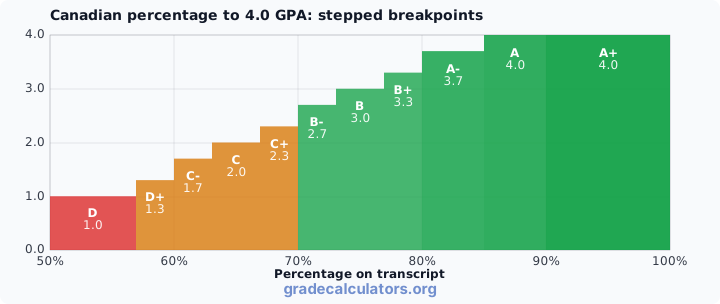
| Percentage range | Letter | 4.0 scale | 4.33 scale | 12-point |
|---|---|---|---|---|
| 90 to 100 | A+ | 4.0 | 4.33 | 12 |
| 85 to 89 | A | 4.0 | 4.0 | 11 |
| 80 to 84 | A- | 3.7 | 3.67 | 10 |
| 77 to 79 | B+ | 3.3 | 3.33 | 9 |
| 73 to 76 | B | 3.0 | 3.0 | 8 |
| 70 to 72 | B- | 2.7 | 2.67 | 7 |
| 67 to 69 | C+ | 2.3 | 2.33 | 6 |
| 63 to 66 | C | 2.0 | 2.0 | 5 |
| 60 to 62 | C- | 1.7 | 1.67 | 4 |
| 57 to 59 | D+ | 1.3 | 1.33 | 3 |
| 50 to 56 | D | 1.0 | 1.0 | 2 |
| Below 50 | F | 0.0 | 0.0 | 0 |
Notable institution-specific deviations: UBC uses a wider A range (80 to 100 percent earns A+, A, or A- without the 5-point internal split most universities apply); Western University sets 80 percent and above as 4.0 (no separate A- band on transcripts); Queen's University uses a slightly higher A- breakpoint (78 to 84 percent for A-, 85 to 89 percent for A); McGill reports both letter and percentage on transcripts but applies its own internal letter-to-GPA conversion. Use the calculator above with the percentage scale toggle, then refer to your institution-specific spoke page below for the exact breakpoints if your university deviates from the standard table.
Canadian University GPA Calculators
Each Canadian university has its own grading scale, percentage-to-GPA conversion, and academic standing thresholds. The institution-specific calculators below cover the 13 most-searched Canadian universities, each preset to that school's exact scale. The Canadian GPA calculator above also works for any of them by selecting the right scale.
- University of Toronto UofT 4.0 scale (since 1989)
- McGill University McGill 4.0 scale
- University of British Columbia UBC Percentage primary, 4.33 conversion
- McMaster University McMaster 12-point scale
- Queen's University Queen's 4.3 scale + percentage
- University of Waterloo Waterloo Percentage primary
- Western University Western Percentage primary, 4.0 conversion
- Simon Fraser University SFU 4.33 scale
- York University York 9-point and 4.0 scales
- University of Guelph Guelph Percentage primary
- Seneca Polytechnic Seneca 4.0 scale
- UofT Mississauga UTM 4.0 scale (UofT system)
- Wilfrid Laurier University Laurier 12-point scale
How to Convert a Canadian GPA to the US 4.0 Scale
Canadian students applying to US graduate schools, professional programs (medicine, law, business), or US universities for transfer admission typically need to report their GPA on the US 4.0 scale. The conversion depends on which Canadian scale you started from:
- From the 4.0 scale. No conversion needed. Your transcript GPA is already on the US 4.0 scale. Report it as-is.
- From the 4.33 scale. Most US graduate schools and law schools accept the 4.33 value as-is and treat it as equivalent to a 4.0 with extra credit for A+ work. A small number of US programs strictly cap GPA at 4.0; in those cases, cap your reported GPA at 4.0 (an applicant with a 4.20 reports 4.0). The 4.33 scale was designed to be transparent across both systems, so most US admissions committees understand it without conversion.
- From the 12-point scale. Divide by 3. A 12-point GPA of 10.5 converts to a US 4.0 equivalent of 3.5; a 12-point of 11.4 converts to 3.8. McMaster and Wilfrid Laurier provide official letters confirming the conversion when students request them; OMSAS, LSAC, and AACOMAS use a slightly different conversion table, so check with the specific application service for their published mapping.
- From the percentage scale. Use the percentage to 4.0 GPA table above. UBC, Waterloo, Guelph, and Western typically include both percentage and 4.0 GPA on official transcripts when the student requests a US-format transcript; alternatively, World Education Services (WES) provides credential evaluation services that most US graduate schools accept.
For competitive US graduate school applications (especially law and medicine), consider getting a third-party WES evaluation. WES converts your Canadian transcript course-by-course to the US 4.0 scale using their published conversion tables, which most US graduate schools accept as the canonical conversion. The cost is typically 200 to 250 USD for a full course-by-course evaluation; LSAC, AACOMAS, and AADSAS handle their own conversions for law, osteopathic medical, and dental school applications respectively.
Academic Standing at Canadian Universities
Canadian universities classify students into academic standing categories based on their GPA. The thresholds vary by institution but typical Canadian benchmarks on the 4.0 scale:
- First-Class Honours (3.7 or above on 4.0): The highest undergraduate degree designation in Canada. Most universities require a cumulative GPA of 3.7 or above (or 80 percent or above on percentage transcripts) across the final two years of study. First-Class Honours is required for most graduate program admissions and competitive scholarships.
- Second-Class Honours, Upper Division (3.3 to 3.69): Solid B+ to A- cumulative range. Sufficient for most master's programs and many professional programs. UofT, Western, McGill, and Queen's use this designation; UBC reports comparable standing as "Distinction".
- Second-Class Honours, Lower Division (3.0 to 3.29): Solid B range. Good standing at most universities; sufficient for most general-stream graduate programs but typically below the cutoff for highly competitive programs.
- Pass standing (2.0 to 2.99): Meets the graduation minimum at most Canadian universities. Sufficient to graduate but may limit graduate school options. Some programs (e.g., engineering, nursing) require a minimum 2.5 GPA in major-related courses for graduation.
- Academic probation (below 2.0): Triggered at most universities when cumulative GPA falls below 2.0. Students on probation typically have one to two terms to bring their GPA above the threshold or face suspension. Some universities require a minimum 1.5 in any term to avoid immediate suspension.
Dean's List eligibility is separate from honours classification and requires a high single-term GPA (usually 3.7 or above on the 4.0 scale, or 80 percent and above on percentage transcripts) plus a minimum credit load (typically 12 to 15 credits per term). Dean's List is reported each term; honours classification is final at graduation. The calculator above flags Dean's List eligibility automatically when your GPA reaches 3.5 (the most common Dean's List cutoff) and First-Class Honours when you reach 3.7.
How to Find Cumulative GPA vs Sessional GPA on a Canadian Transcript
Canadian transcripts typically report two GPAs: the sessional (single-term) GPA and the cumulative GPA. Understanding the difference matters for grad school and professional program applications:
- Sessional GPA reflects only the courses taken in a single term (fall, winter, or spring/summer). Used for Dean's List eligibility and academic probation decisions. A strong sessional can show recent improvement; a weak sessional after strong terms can flag a downturn.
- Cumulative GPA is the credit-weighted average across all completed courses to date. The figure that appears as "GPA" on your transcript and the figure most graduate school applications request.
- Last 60 credits GPA / Last two years GPA is reported separately for graduate school applications at most Canadian universities. OMSAS (Ontario med schools), LSAC (Canadian law schools), and most master's programs request this calculation specifically because it reflects your most recent academic performance and gives more weight to upper-year courses.
- Major GPA / Subject GPA covers only courses in your declared major or a specific subject area. Used for honours-program admissions and major-specific scholarships at most Canadian universities.
To calculate any of these GPAs, use the calculator above with only the relevant courses entered. For multi-term cumulative calculations, the cumulative GPA calculator handles credit-weighted aggregation of multiple term GPAs. For a Canadian-specific last-60-credits calculation, enter only your most recent 60 credits (typically 20 courses at 3 credits each, or 10 full-year courses at 6 credits each).
How GPA Affects Canadian Graduate School and Professional Programs
Different Canadian post-graduate programs weight GPA differently. Knowing the typical thresholds helps you target schools where your GPA is competitive:
- Medical school (Canadian MD programs): OMSAS reports the median accepted GPA across Ontario med schools at 3.85 on the 4.0 scale; UBC Medicine reports a typical accepted GPA at 86 percent or above. Most Canadian med schools use the cumulative undergraduate GPA, last two years GPA, or both as their primary academic screening criterion. McMaster Medical School also weighs the MCAT CARS section heavily, partially offsetting GPA.
- Law school (Canadian JD programs): LSAC reports the median accepted GPA at top Canadian law schools (UofT Law, Osgoode Hall, McGill Law) at 3.7 to 3.9 on the 4.0 scale, paired with an LSAT in the 162 to 168 range. UofT Law specifically uses the best three years GPA (after dropping the lowest year). Saskatchewan Law and Manitoba Law have lower median accepted GPAs in the 3.4 to 3.6 range with stronger LSAT compensating.
- Master's programs (research-thesis): Most Canadian research-thesis master's programs require a minimum 3.0 cumulative GPA (or 75 percent on percentage transcripts) for admission, with a minimum 3.3 in the proposed field. Highly competitive programs (computer science at UofT, MBA at Rotman or Ivey, engineering at McGill or Waterloo) typically expect 3.7 or above.
- Master's programs (professional / course-based): Threshold typically 3.0 cumulative; some programs accept lower GPA with relevant work experience or research output substituting for academic strength.
- PhD programs: Direct-entry PhDs typically require 3.7 or above cumulative GPA in the master's degree (or final two years of undergraduate for combined-program admission). Funding (NSERC, SSHRC, CIHR) requires a minimum 3.7 GPA at most Canadian universities.
For US-bound applicants from Canada, the GPA bars at top US programs are typically slightly lower because US graduate admissions weigh GRE scores, research experience, and recommendation letters more heavily than the GPA-dominant Canadian model. WES evaluation (200 to 250 USD) is the standard pathway for converting your Canadian GPA to the US 4.0 format that most US grad schools require.
This calculator estimates Canadian university GPAs using the four common Canadian grading scales and standard percentage-to-GPA conversion breakpoints. Specific universities may shift breakpoints by 1 to 3 percentage points; for institution-specific calculators, see the university directory above. For graduate school applications, always verify with your target institution's admissions office and consult World Education Services (WES) for the canonical Canadian to US 4.0 GPA conversion. For Ontario medical schools, see OMSAS; for Canadian law schools, see LSAC Canada.