Toggle any course to Drop with W, WF, or P/F election and watch the GPA shift live. The before column shows what the GPA would be if every course stayed graded; the after column shows the impact of your status choices.
| Course | Credits | Grade | Status | Remove |
|---|
Letter grade reference (standard 4.0 scale)
| Letter | GPA Points | Percentage |
|---|---|---|
| A+ | 4.0 | 97-100% |
| A | 4.0 | 93-96% |
| A- | 3.7 | 90-92% |
| B+ | 3.3 | 87-89% |
| B | 3.0 | 83-86% |
| B- | 2.7 | 80-82% |
| C+ | 2.3 | 77-79% |
| C | 2.0 | 73-76% |
| C- | 1.7 | 70-72% |
| D | 1.0 | 60-69% |
| F | 0.0 | Below 60% |
Does Dropping a Class Affect Your GPA?
A class dropped during the add/drop window leaves no mark on the transcript and has zero effect on the GPA. A class withdrawn after the add/drop deadline records a W on the transcript at most US universities and is also GPA-neutral: no quality points enter the numerator, no credit hours enter the denominator. The W counts on the transcript as an attempted-but-not-graded course, which matters for federal financial aid Satisfactory Academic Progress but not for the cumulative GPA number itself.
The exception is WF, short for Withdraw Failing. A handful of institutions use WF when a student withdraws late from a course they were failing. WF counts as an F in the GPA calculation: 0 quality points, credit hours in the denominator. The drop class GPA calculator above models all three cases. Set a row to Drop with W to remove it from both sides of the GPA formula. Set it to WF to add 0 quality points while keeping the credit hours.
Does Dropping a Class Affect Your GPA in High School?
The same logic applies in high school, with two practical differences. High school drops more often happen inside the add/drop window because semesters are longer, so the dropped course is more likely to never appear on the transcript at all. Second, high school transcripts read by college admissions reviewers care more about pattern than impact: a single drop is unremarkable, but multiple drops across semesters can read as course-rigor avoidance. The GPA-impact math is identical to college: drops are excluded from the GPA formula.
Does Pass Fail Class Affect GPA?
A pass/fail class affects GPA only when you fail. A P grade on a pass/fail election excludes the course from both the numerator and the denominator of the GPA formula at most US universities, so the GPA stays exactly where it would have been without that course. The University of Michigan, UNC Chapel Hill, Stanford, and most Big Ten and Ivy League schools follow this rule. A failed P/F election records as F at the same schools: 0 quality points, credit hours in the denominator, full GPA impact.
The drop class GPA calculator above treats P/F election the same way. Toggle a row's Status to P/F election and a grade of D- or higher is excluded from the GPA formula. A grade of F under P/F still counts at 0.0. This matches the registrar treatment at every major US institution we cross-checked.
How Does a Pass Fail Class Get Calculated into GPA at Different Schools?
Pass/fail policy varies in three ways across institutions. First, the floor: most schools set the pass threshold at D- (0.7), but a few set it at C (2.0) for major requirements or graduate coursework. Second, the cap: most schools limit pass/fail to one course per semester or four to six courses total across the undergraduate degree. Third, the transcript flag: some schools record the underlying letter grade plus a P/F notation, others record only P or F. The drop class GPA calculator above uses the most common rule, D- or above counts as P, anything lower counts as F, but always verify with your registrar before relying on the projection.
How Much Does an F Drop Your GPA?
A failed course adds 0 quality points to the numerator while still adding credit hours to the denominator, so it pulls the average down by an amount proportional to how many credits the F carries and how thin your existing credit base is. The math is exact: New GPA = (Current GPA x Earned Credits + 0 x F Credits) / (Earned Credits + F Credits). The thinner the credit base, the larger the per-F drop. A first-semester freshman with one F in a 4-credit course alongside two 3-credit Bs and one 3-credit A is at (3.0 x 3 + 3.0 x 3 + 4.0 x 3 + 0.0 x 4) / 13 = 30/13 = 2.31. The same student in their senior year with 90 graded credits before the F drops by roughly 0.13 points instead of 1.0+.
How Much Does an F Drop Your GPA If You Retake the Course?
Most US undergraduate institutions offer grade replacement for one to four repeated courses across the degree. When grade replacement applies, the F drops out of the GPA calculation and the retake grade replaces it. Without grade replacement, both grades count. The drop class GPA calculator above is a single-term calculator; for retake modeling across multiple terms, use the cumulative GPA calculator and enter the retake as a new row in a later semester. AMCAS, LSAC, AACOMAS, and CASPA count every attempt of every course in their application GPAs, ignoring school-side grade replacement entirely.
Drop Class GPA Formula and Withdrawal Math
- Graded row: grade points = standard 4.0-scale value, credit hours in denominator
- W (Withdrawn) row: excluded from numerator and denominator entirely
- WF (Withdraw Failing) row: 0 grade points, credit hours stay in denominator
- P/F election, passing grade: excluded from both sides (no GPA impact)
- P/F election, failing grade: 0 grade points, credit hours in denominator
Two practical insights fall out of this formula. Dropping a failing course with a W produces a larger GPA recovery than passing the course with a D or C-minus, because the W removes the low-quality-point row entirely. And WF carries the same GPA impact as a graded F, so if your registrar offers a choice between WF and a graded F at the late drop deadline, the GPA math is identical and the choice should be made on transcript readability, not GPA impact.
GPA Impact Magnitude Chart
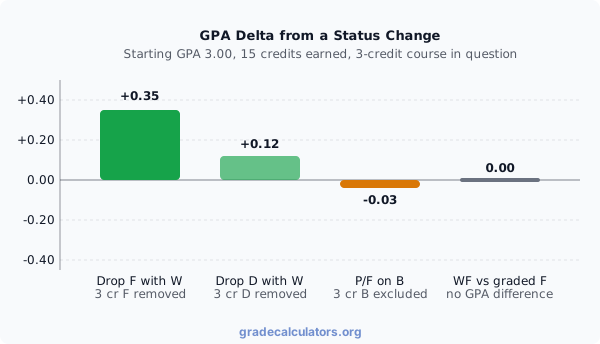
How to Calculate GPA with a Dropped Class Versus a Failed Class
The arithmetic is asymmetric in a way that surprises most students. Dropping a course removes its row entirely. A failed course (or a WF) adds 0 quality points but keeps the credit hours in the denominator. So a 3-credit F at a starting GPA of 3.00 pulls the cumulative to (3.00 x 15 + 0 x 3) / 18 = 2.50, a drop of 0.50 points. The same course dropped with a W stays at 3.00 (no row in the formula). That 0.50-point gap is the practical reason academic advisors recommend a W over riding out a failing grade when the registrar still permits the late drop. The drop class GPA calculator above shows this exact comparison: toggle the same row between Keep (graded F) and Drop with W to see the delta in real time.
How to Calculate GPA with Withdrawal for Application Services
LSAC, AMCAS, AACOMAS, and CASPA all treat a W on the transcript as GPA-neutral for the application GPA. They count the course as attempted but exclude it from the GPA formula, matching the registrar treatment. However, every W still appears on the transcript copy these services submit to the applying schools, and excessive W grades can prompt application reviewers to ask about the pattern. The rule of thumb from law and medical school admissions offices: one or two W grades across an undergraduate transcript are unremarkable; three or more invite questions; six or more typically require an explanation in the application essay.
How Do You Calculate GPA with a Dropped Class for LSAC and AMCAS?
For application-service GPAs, exclude any row with a W from the GPA formula. The drop class GPA calculator above does this automatically when you set a row's Status to Drop with W. The difference between school-transcript GPA and application-service GPA shows up in two other places: retaken courses (AMCAS and LSAC count every attempt; many schools count only the retake) and pass/fail conversions (some schools exclude P grades; AMCAS counts P at 0 in the science-GPA formula for any course taken P/F during the pandemic). When in doubt, the every-attempt math is the safer planning baseline. See our AMCAS GPA calculator and LSAC GPA calculator for the application-side math.
Tips for Using the Drop Class GPA Calculator Effectively
- Check the deadline before you toggle. Most universities have a hard withdrawal deadline around the 60th day of the term. After that, a W may not be available and the course converts to a graded letter or WF. Confirm the date on the registrar's academic calendar.
- Run both scenarios. Set the row once to Keep with the projected letter grade, then again to Drop with W. The delta between the two is the actual GPA impact of the drop. The drop class GPA calculator above shows both columns simultaneously.
- Distinguish W from WF. If your school uses WF for late drops from failing courses, the GPA math is identical to a graded F. The W status is GPA-neutral; the WF status is not.
- Account for financial aid SAP separately. A W is GPA-neutral but counts as attempted-not-earned for federal Satisfactory Academic Progress. Excessive W grades can trigger SAP review even when the GPA looks fine.
- Verify pass/fail caps. Most schools cap P/F election at one course per semester or four to six courses across the degree, and exclude major requirements. The calculator does not enforce caps; check with your registrar.
- For multi-semester planning, combine with the cumulative GPA calculator. This calculator is a single-term tool; cumulative impact requires the prior cumulative GPA as a seed.
Sources: NACADA Global Community for Academic Advising guidance on withdrawal counseling, AACRAO American Association of Collegiate Registrars and Admissions Officers standards on W and WF transcript notation, AMCAS Grade Conversion Guide on withdrawal and pass/fail treatment in the medical school application GPA, LSAC Academic Summarization on every-attempt counting for law school applications, and registrar policy pages at UC Santa Cruz and UNC Chapel Hill.
Always verify the GPA impact with your specific school's registrar before relying on a calculated projection for an academic, financial, or application decision. Withdrawal deadlines, WF policies, and pass/fail caps vary by institution and by program.