What semester GPA do I need to reach my target?
How many credits and semesters until I reach my target?
Letter grade reference (standard plus/minus scale)
| Letter | GPA Points | Percentage |
|---|---|---|
| A+ | 4.0 | 97-100% |
| A | 4.0 | 93-96% |
| A- | 3.7 | 90-92% |
| B+ | 3.3 | 87-89% |
| B | 3.0 | 83-86% |
| B- | 2.7 | 80-82% |
| C+ | 2.3 | 77-79% |
| C | 2.0 | 73-76% |
| C- | 1.7 | 70-72% |
| D | 1.0 | 60-69% |
| F | 0.0 | Below 60% |
Raise GPA Calculator Formula: Required Semester GPA Math
The raise GPA calculator above reverses the standard GPA formula to solve for the unknown: the semester average you need across a fixed number of planned credits to reach your target cumulative GPA. The more credits you add to the runway, the lower that required average becomes. The formula below shows the exact arithmetic.
Required Semester GPA Formula
- Current GPA = your cumulative GPA on the transcript today
- Credits Earned = credit hours already counted toward the cumulative GPA
- Target GPA = the cumulative GPA you want to reach
- Planned Credits = credit hours you will earn before the target date
Percent to Goal Calculator: GPA Progress Tracking
A percent-to-goal calculator tracks progress toward a numeric target, in this case a target cumulative GPA. When the required semester GPA exceeds 4.0, three options exist: extend the credit runway, lower the target, or ask your registrar whether grade replacement for retaken courses applies. Grade replacement swaps an old D or F with the retaken grade on the GPA calculation rather than averaging it in, which can move the cumulative number faster than earning new As. Use Mode 2 of the calculator to see the credits-and-semesters timeline at any expected semester GPA.
What Grades Do I Need to Raise My GPA?
The table below shows the required semester GPA for a student currently at 3.0 after 60 credits, across three common targets and two runway lengths. Use the calculator above for your exact starting numbers.
| Target GPA | 30 more credits needed | 60 more credits needed | Achievable? |
|---|---|---|---|
| 3.0 | 3.0 (B) | 3.0 (B) | Yes |
| 3.2 | 3.6 (B+/A-) | 3.3 (B+) | Yes |
| 3.5 | 4.0 (A only) | 3.75 (A-) | Strict |
| 3.8 | 4.6 (impossible) | 4.3 (impossible) | No on 4.0 scale |
What Grades Do You Need for a 3.0 GPA?
Straight Bs maintain a 3.0 GPA if that is your current standing. To climb from below 3.0, you need a semester average above 3.0. A student at 2.7 after 60 credits wanting 3.0 after 30 more credits requires a (3.0 x 90 - 2.7 x 60) / 30 = 3.6 average, between B+ and A-. Every A (4.0) in a course offsets one C (2.0) of equal credit weight toward the 3.0 target.
What Grades Do You Need for a 3.5 and 3.8 GPA?
Reaching 3.5 from below requires a semester average above 3.5. From 3.0 after 60 credits, you need a 4.0 average on 30 more credits (straight As) or a 3.75 average on 60 more credits. Reaching 3.8 from most starting points is mathematically impossible in a single year. From 3.0 after 60 credits on 30 more credits, the required average is 4.6, which exceeds the 4.0 ceiling. Even from 3.6 after 60 credits on 60 more credits, the required average is (3.8 x 120 - 3.6 x 60) / 60 = 4.0, straight As only. The further below 3.8 you start, the more credits you need in the runway to make it reachable.
How Much Can You Raise Your GPA in One Semester?
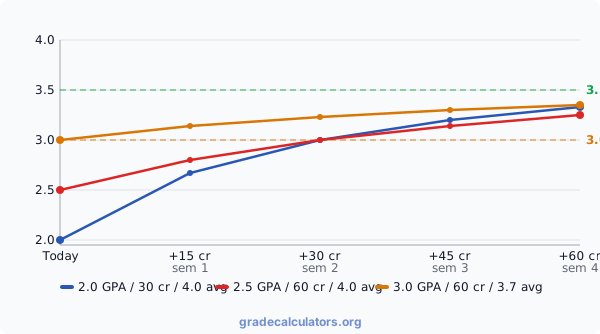
The chart illustrates the core insight of raise-GPA planning: the cumulative average improves fastest when the credit base is smallest. A student with 30 credits of history sees larger per-semester GPA jumps than a student with 90 credits earning the same grades. This is why academic advisors recommend addressing a weak GPA early, as the runway is longest when the base is lightest.
Also notice that the blue line (2.0 GPA / 30 credits) and the red line (2.5 GPA / 60 credits) cross the 3.0 threshold at the same point despite starting at different places. Both paths converge because the lighter base of the 2.0 student allows faster-per-semester gains that offset the larger gap. Use Mode 2 of the calculator above to model your own timeline.
GPA Thresholds: Scholarships, Honors, and Graduate School
Knowing your target GPA matters only if it maps to a real academic or financial milestone. The thresholds below reflect standards at most US institutions and scholarship programs; always confirm with your specific registrar or award sponsor.
- 2.0: Minimum satisfactory standing at most institutions. Below this, academic probation typically follows, with financial-aid implications under FAFSA Satisfactory Academic Progress (SAP) rules.
- 3.0: Common requirement for graduate program admission, state merit scholarships (Georgia HOPE, Florida Bright Futures basic award), and many transfer-admission processes at state flagship universities.
- 3.5: Dean's List threshold at most universities, merit scholarship maintenance floor at many institutions, and minimum GPA for competitive graduate programs in business, education, and social sciences.
- 3.7: Summa cum laude or top-tier honors at many schools. Competitive threshold for law school and medical school applicants, per LSAC and AAMC data.
- 3.8+: Target range for top-ranked graduate and professional programs. Phi Beta Kappa academic honor society requires a minimum 3.8 at most chapters. Private merit scholarships often set floors in this range.
Some programs use major GPA or institutional GPA rather than cumulative, which can differ from the transcript total. Ask your registrar which GPA type applies before planning around a specific threshold. Source: US Department of Education NCES grading policy data and NACAC admissions guidance.
Always verify GPA calculations with your specific school's registrar. Grading policies, GPA scales, and grade replacement rules vary by institution.