| Course | Grade level | Grade | Type | |
|---|---|---|---|---|
UC letter grade and honors reference
| Letter | UC points | UC honors bonus |
|---|---|---|
| A (with or without plus or minus) | 4.0 | +1 if honors, AP, or IB |
| B (with or without plus or minus) | 3.0 | +1 if honors, AP, or IB |
| C (with or without plus or minus) | 2.0 | +1 if honors, AP, or IB |
| D (with or without plus or minus) | 1.0 | None (D blocks the honors bonus) |
| F | 0.0 | None (F blocks the honors bonus) |
UC drops plus and minus modifiers. Honors bonus is +1 per UC-approved honors, AP, or IB semester, capped at 8 semesters total (no more than 4 from 10th grade) for the UC capped weighted GPA. Source: UC Admissions GPA Requirement page.
How the California GPA Calculator Works
This California GPA calculator runs the three GPA formulas UC admissions evaluates on every application. The UC Capped Weighted mode is the default because it is the figure UC actually uses for the 3.0 California-resident minimum and the 3.4 nonresident minimum. The Fully Weighted mode shows what your GPA would look like without the 8-semester cap. The Unweighted mode strips out the honors bonus entirely. Toggle the mode and the headline figure updates, while the stat-card tracker keeps all three values visible side-by-side so you can read across.
Students searching for a "california gpa calculator", "california high school gpa calculator", or "gpa calculator california" all land on this same hub page. The California GPA calculation is governed by UC and CSU admissions policy at the state level rather than at the district level, so one calculator covers the core calculation for any California public high school student. Below the calculator, this page covers the A-G course list, the UC 8-semester honors cap, how CSU computes its Eligibility Index, the standard California high school transcript GPA, and how to convert your California GPA when applying to out-of-state universities.
California A-G Course Requirements
Both the University of California and the California State University systems compute admissions GPA from the A-G course list, a 15-course minimum set of college-preparatory subjects every California public high school must offer. Only A-G courses count toward the UC and CSU GPA calculations; PE, study hall, teacher assistant periods, and school-specific electives without A-G certification are excluded.
- (a) History and Social Science: 2 years required (typically World History plus US History, or US History plus Government and Economics).
- (b) English: 4 years required (English 9, 10, 11, and 12 or AP equivalents).
- (c) Mathematics: 3 years required, 4 recommended (Algebra 1, Geometry, Algebra 2 minimum; Pre-Calculus or Calculus recommended for STEM majors).
- (d) Laboratory Science: 2 years required, 3 recommended (one Biology, one Chemistry or Physics typical; UC engineering and life sciences majors strongly prefer 3 years).
- (e) Language Other Than English: 2 years of the same language required, 3 recommended (Spanish, French, Mandarin, ASL, Latin, and others all qualify when offered).
- (f) Visual and Performing Arts: 1 year required (art, music, dance, drama, or media arts, as long as the course holds A-G certification).
- (g) College-Preparatory Elective: 1 year required (additional A-G course beyond the minimums above; advanced math, additional language, or AP elective are the most common choices).
Courses taken before the summer after 9th grade, including 9th-grade A-G courses, do not count toward the UC GPA. They still appear on the official transcript and count toward graduation requirements. The calculator above lets you flag the grade level for each course so the UC counting window applies correctly.
How UC GPA Is Calculated (Capped Weighted, Fully Weighted, Unweighted)
The University of California applies its own GPA formula during admissions review, separate from whatever GPA your high school reports on the official transcript. UC computes three figures and uses the capped weighted GPA as the eligibility benchmark. According to the UC Admissions GPA Requirement page, students should not round their calculated GPA when submitting an application.
- Grade Points: A = 4, B = 3, C = 2, D = 1, F = 0 (plus and minus modifiers are ignored)
- Capped Honors Bonus: +1 per semester of UC-approved Honors, AP, or IB course, capped at 8 semesters total across 10th and 11th grade, with no more than 4 from 10th grade
- A-G Semester Grades: every A-G course counts as 1 semester grade (a full-year course contributes 2 semester grades)
Three GPA figures result from this calculation, each useful for a different purpose:
| GPA Type | Honors Bonus | Cap Applied | Primary Use |
|---|---|---|---|
| UC Capped Weighted | +1 per approved honors, AP, or IB semester | 8 semesters total (max 4 from 10th grade) | UC eligibility check (3.0 CA resident, 3.4 nonresident) |
| Fully Weighted UC | +1 per approved honors, AP, or IB semester | None | CSU Eligibility Index; out-of-state college research |
| Unweighted UC | None | N/A | Some out-of-state schools requesting an unweighted figure |
The calculator above computes all three flavors live as you enter courses. The mode toggle controls which figure appears as the headline; the stat-card shows all three at once so you can read across without switching modes.
The UC 8-Semester Honors Cap, Explained
The 8-semester honors cap is the single most distinctive feature of UC GPA calculation. UC awards a +1 bonus per semester of UC-approved Honors, AP, or IB course taken in 10th or 11th grade, but caps the total bonus at 8 semesters across both years. Within that 8-semester ceiling, no more than 4 semesters can come from 10th grade. Honors courses beyond the cap are counted as standard courses (no bonus point) when UC computes the capped weighted GPA.
A worked example. A student takes 6 AP courses in 10th grade (12 semester grades, all honors-eligible) plus 6 AP courses in 11th grade (another 12 honors-eligible semester grades). The total honors-eligible count is 24 semesters. UC awards the +1 bonus to only 8 of those: 4 from 10th grade (the 10th-grade sub-cap binds at 4) plus 4 from 11th grade (the total cap reaches 8). The remaining 16 honors semesters earn the same points as a standard course at the same letter grade. The capped weighted GPA is therefore lower than the fully weighted GPA, often by 0.2 to 0.4 points for students who take heavy honors loads.
Three additional rules apply. First, the course must be UC-approved (verified at UC Doorways A-G course list) for California residents; for nonresidents, only AP and IB courses receive the bonus, school-designated honors courses do not count. Second, summer courses before 10th grade or after 11th grade attach to the adjacent year for cap counting (summer after 9th attaches to 10th; summer after 11th attaches to 11th). Third, grades of D or F never earn the honors bonus regardless of course type.
CSU GPA and the Eligibility Index
The California State University system uses a related but distinct GPA calculation. CSU counts the same A-G courses, applies the same +1 honors bonus for UC-approved Honors, AP, or IB semesters, but does not apply the 8-semester cap when computing the CSU Eligibility Index. The CSU Admissions requirements combine GPA and standardized test scores into one composite score:
Eligibility Index = (CSU GPA x 800) + SAT total score, OR (CSU GPA x 200) + (ACT composite x 10)
- CSU GPA: weighted A-G GPA with honors bonus (no 8-semester cap)
- SAT total: Math + Evidence-Based Reading and Writing (out of 1600)
- ACT composite: standard 1 to 36 score
Each CSU campus sets its own Eligibility Index threshold by major and applicant type. California residents typically need an Eligibility Index of 2,900 to 3,200 for most CSU campuses; impacted majors at high-demand campuses (San Diego State, Cal Poly Pomona, Long Beach State, Fullerton) require higher thresholds in the 3,500 to 4,200 range. Cal Poly San Luis Obispo uses a separate Multi-Criteria Admissions (MCA) score that incorporates GPA, test scores, course rigor, and major-specific factors, with no fixed minimum.
The Fully Weighted UC GPA mode in the calculator above gives the closest approximation of the CSU GPA used for the Eligibility Index. For a campus-specific CSU calculation, see the CSU GPA calculator; for Cal Poly specifically, the Cal Poly GPA calculator handles MCA scoring.
UC Campus GPA Ranges for Admitted Students
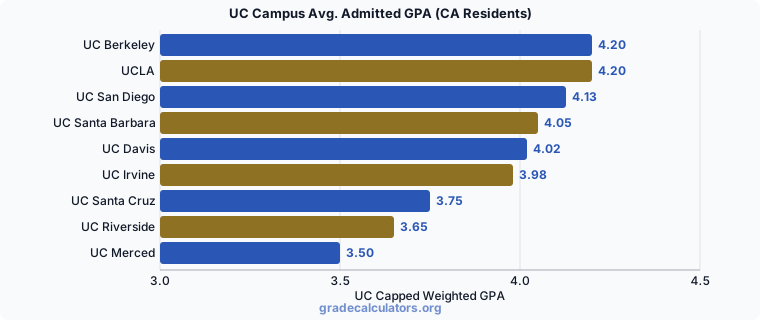
UC uses the capped weighted GPA as its eligibility baseline, but each campus runs its own full-application review when making admissions decisions. The table below shows approximate middle-50% UC capped weighted GPA ranges for recently admitted first-year California residents, based on published UC admissions data and campus fact sheets. These are descriptive ranges, not guarantees.
| Campus | Middle 50% GPA Range | Notes |
|---|---|---|
| UC Berkeley | 4.10 to 4.30 | Most selective; engineering and CS higher |
| UCLA | 4.10 to 4.30 | Most selective; business and nursing higher |
| UC San Diego | 4.00 to 4.25 | STEM-heavy admits; Revelle and Muir colleges |
| UC Santa Barbara | 3.90 to 4.20 | Engineering and physical sciences at higher end |
| UC Davis | 3.85 to 4.18 | Veterinary and biological sciences competitive |
| UC Irvine | 3.80 to 4.15 | Computer science and business on higher end |
| UC Santa Cruz | 3.50 to 4.00 | Broader acceptance range across majors |
| UC Riverside | 3.40 to 3.90 | Guaranteed admission pathway for CA students at 3.0 |
| UC Merced | 3.20 to 3.80 | Most accessible UC; 3.0 minimum with Eligibility Index |
California University GPA Calculators
Each California public university recalculates applicant GPA using the UC or CSU rules above plus campus-specific adjustments. The dedicated calculators below cover the most-searched California institutions with their exact admissions thresholds and weighting policies:
- University of California (UC) System UC System UC weighted-capped 4.0 (max ~4.40 capped)
- UC Berkeley UCB UC weighted-capped 4.0
- UCLA UCLA UC weighted-capped 4.0
- UC San Diego UCSD UC weighted-capped 4.0
- UC Santa Barbara UCSB UC weighted-capped 4.0
- California State University (CSU) CSU CSU eligibility index, 4.0 base
- Cal Poly San Luis Obispo Cal Poly CSU-system 4.0 plus MCA score
California High School Transcript GPA
California high schools report GPA on the official transcript using a standard 4.0 unweighted scale with plus or minus modifiers (A+ = 4.0, A = 4.0, A- = 3.7, B+ = 3.3, B = 3.0, B- = 2.7, C+ = 2.3, C = 2.0, C- = 1.7, D+ = 1.3, D = 1.0, F = 0). Most districts also report a weighted GPA that adds a bonus for Honors, AP, or IB courses. The key rule every California student should know: the GPA on your transcript is NOT the figure UC or CSU admissions will use. Both systems recalculate it from scratch using their own rules. According to the California Department of Education, transcript GPA policies vary by district, but the UC and CSU recalculations are standardized statewide.
For the NCAA and NAIA athletic eligibility centers, the standard transcript GPA (all courses, unweighted 4.0 scale with plus or minus) is the figure used. The high school GPA calculator handles the standard transcript calculation with plus or minus support.
Converting California GPA for Out-of-State and Private University Applications
California students applying to out-of-state public flagships (Michigan, Virginia, North Carolina, Texas), private universities (Stanford, USC, the Ivies), and Common Application schools should report the standard transcript GPA rather than the UC-recalculated figure. Three rules apply when filling out those forms:
- Use the unweighted 4.0 transcript GPA as the primary GPA on Common App and Coalition App, unless the school specifically requests a weighted version. Plus or minus values are included.
- Report the weighted GPA as the secondary figure on application forms that ask for both. Most California districts cap weighted GPA at 4.5 or 5.0; the form accepts either format.
- Do not report the UC capped weighted GPA outside the UC and CSU systems. The capped figure is a UC-specific calculation and will confuse out-of-state admissions readers who expect a 0.0 to 5.0 weighted range without the cap rule.
For graduate school applications (medical school, law school, business school) made by California undergraduates, the cumulative undergraduate GPA on the official transcript is the figure used. AMCAS (medical school), LSAC (law school), and AACOMAS (osteopathic medical) all apply their own GPA recalculations. See the standard GPA calculator for the 4.0 scale used in those calculations, or the college GPA calculator for semester-by-semester GPA tracking.
UC vs. CSU GPA Requirements: Key Differences
The two California public university systems share the A-G course foundation but apply different rules after that. A student targeting both UC and CSU schools should calculate both figures. The Fully Weighted mode in this calculator approximates the CSU GPA; the Capped Weighted mode is what UC sees.
Use the weighted grade calculator to project how a current semester's remaining assignments will affect your cumulative GPA before the application deadline.
This California GPA calculator estimates UC and CSU GPAs using the official A-G course rules, the +1 honors bonus, and the UC 8-semester honors cap as documented on the University of California Admissions GPA requirement page. Specific campuses may apply additional adjustments during application review. For binding admissions decisions, verify with the UC Admissions GPA Requirement page, the CSU Admissions requirements, the UC Doorways A-G course list, the California Department of Education, and the Cal Poly San Luis Obispo Admissions page for campus-specific rules. AP credit policies referenced from College Board AP Students. Last verified: May 2026.