Calculate your cumulative GPA
Already have a cumulative GPA? Update it with new semesters below.
| Semester | GPA | Credits | Remove |
|---|---|---|---|
Letter grade reference (4.0 scale)
| Letter | Points | Range |
|---|---|---|
| A+ | 4.0* | 97-100% |
| A | 4.0 | 93-96% |
| A- | 3.7 | 90-92% |
| B+ | 3.3 | 87-89% |
| B | 3.0 | 83-86% |
| B- | 2.7 | 80-82% |
| C+ | 2.3 | 77-79% |
| C | 2.0 | 73-76% |
| C- | 1.7 | 70-72% |
| D+ | 1.3 | 67-69% |
| D | 1.0 | 63-66% |
| D- | 0.7 | 60-62% |
| F | 0.0 | Below 60% |
* A+ GPA = 4.0 at most US colleges; a minority award 4.3.
Cumulative GPA Meaning and How the Credit-Weighted Formula Works
The cumulative GPA meaning is a single credit-weighted number: your grade point average across every academic term you have completed at one institution. It is the figure printed at the bottom of your official transcript and the one graduate programs, scholarship boards, and employers see when they request your academic record.
Unlike semester GPA, which resets each term, cumulative GPA builds over your entire academic career. The formula weights each semester by the credit hours you carried, so a 16-credit fall counts more than a 6-credit summer session, even if both produced the same GPA. That weighting is what makes the cumulative number more stable and more reliable as a long-term academic measure.
Calculating cumulative GPA: the formula
- Semester GPA = your grade point average for one term (0.00 to 4.00)
- Credits = total credit hours completed that semester (excludes withdrawals and P/F-only terms)
- Σ = the sum across every semester you are including in the calculation
Figuring out cumulative GPA step by step
- Multiply each semester's GPA by its credit hours to produce quality points for that term. A 3.5 GPA over 15 credits yields 52.5 quality points; a 3.5 over 6 credits yields only 21.
- Sum the quality points across every semester on your transcript.
- Sum the total credit hours across every semester.
- Divide total quality points by total credits. That result is your cumulative GPA on the 4.0 scale, the same number a registrar prints on an official transcript.
How schools define cumulative GPA
Schools define cumulative GPA consistently as the credit-weighted average of all graded coursework completed at that institution. "Accumulative GPA" is an alternate spelling that appears on some transcripts and student portal screens, but the two terms are identical. What varies by institution is which courses count: some schools exclude remedial courses, others fold summer sessions into the running total, and a few separate transfer credits from the home-institution average. Check your academic catalog or degree audit screen to see which definition your school uses.
Why credit hours matter when computing cumulative GPA
Credit hours are the weighting factor in every cumulative GPA calculation. A 2.8 in an 18-credit semester pulls down your cumulative more than a 2.8 in a 12-credit semester would, because the heavier load multiplies the impact of that grade across more quality points. Conversely, a strong semester with a full course load does more to lift your cumulative than an equally strong 6-credit summer session. This is why two students with identical semester GPAs can have different cumulative GPAs: the one who carried heavier loads in their stronger semesters ends up higher.
Semester GPA vs Cumulative GPA: How the Running Average Builds
The chart below shows a four-semester example. Each bar represents one semester's GPA. The blue line shows how the running cumulative GPA shifts after each semester is added to the weighted average.
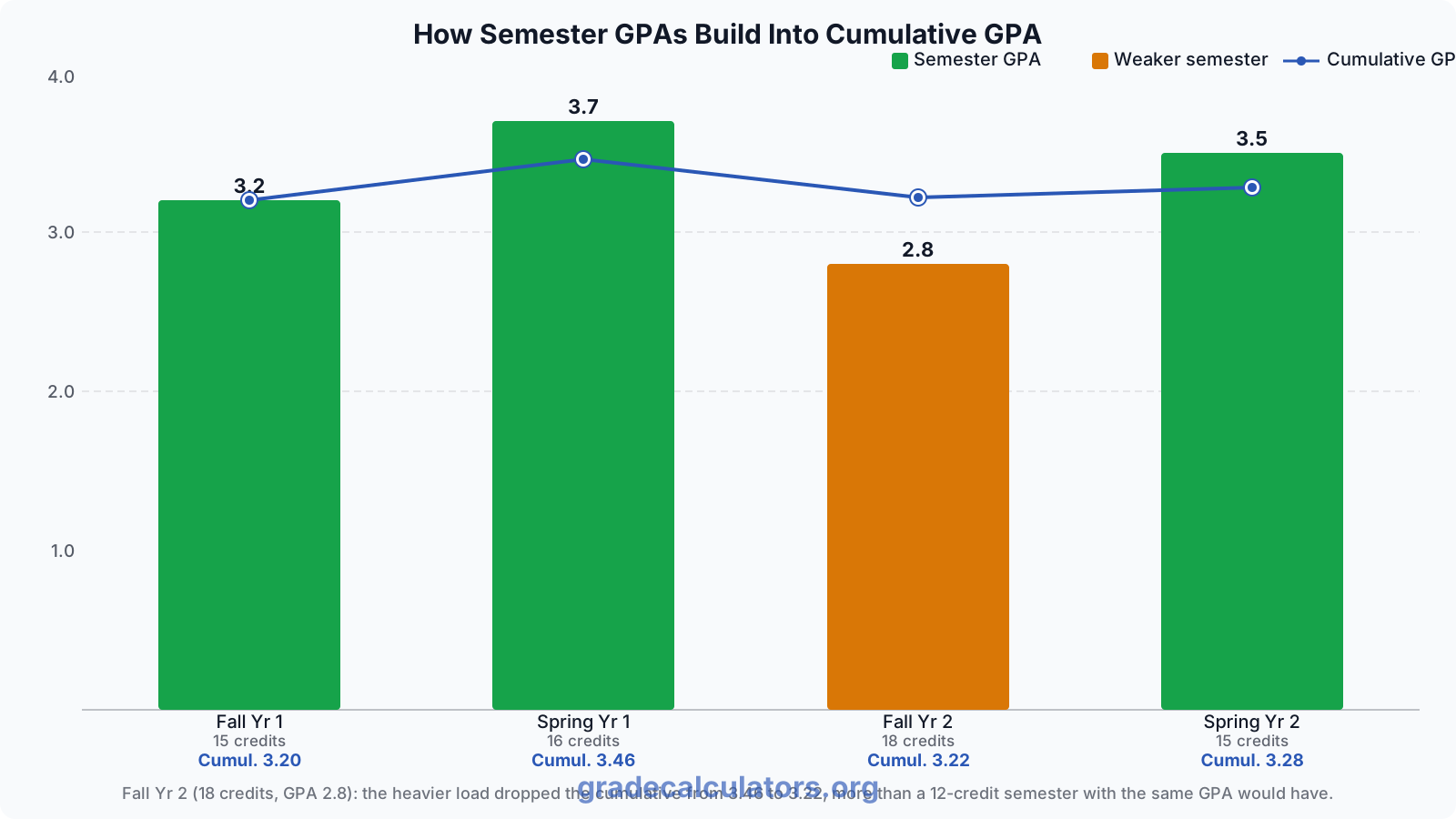
The key insight: credit hours amplify GPA impact in both directions. A great semester with a heavy load lifts your cumulative substantially. A rough semester with a heavy load can erase gains from several lighter terms. When you are calculating cumulative GPA and projecting future semesters, the credit hours you plan to carry matter as much as the GPA you aim for.
Determine Cumulative GPA Thresholds for Common Academic Goals
The cumulative GPA number on your transcript opens or closes specific doors. Use the table below to determine cumulative GPA targets for the most common student goals.
| Goal | Typical Cumulative GPA Required |
|---|---|
| Graduate from most US colleges | 2.0 minimum |
| Avoid academic probation | 2.0 minimum (varies by school) |
| Cum Laude (Latin honors) | 3.5 (varies by institution) |
| Magna Cum Laude | 3.7 (varies by institution) |
| Summa Cum Laude | 3.9 (varies by institution) |
| Most master's programs | 3.0 minimum for admission |
| Competitive PhD programs | 3.5 in major coursework |
| Merit scholarship renewal | 3.0 to 3.5 (program-specific) |
| Dean's List at most schools | 3.5 per semester |
Always verify with your specific school's registrar. Latin honors thresholds and academic standing policies vary by institution. The College Board and NCES publish grading trend data; individual cutoffs are set by each school's academic senate.
Compute Cumulative GPA When You Already Have an Existing GPA
Many students arrive mid-degree with a known cumulative GPA and want to see how a new semester will move it. This is the most common use of the gpa calculator with current gpa: you know your existing standing and need to fold in new data. The optional "Prior Cumulative GPA" fields at the top of the calculator handle this.
How to calculate your cumulative GPA with a prior seed
Enter your current cumulative GPA and the total credits you have completed. The calculator seeds those values and combines them with each new semester row you add. For example: a student carrying a 3.2 cumulative GPA over 60 completed credits earns a 3.8 in a new 15-credit semester. Updated cumulative GPA = (3.2 x 60 + 3.8 x 15) / (60 + 15) = (192 + 57) / 75 = 3.32. The new semester moved the cumulative by 0.12 points because 15 credits against 60 prior credits is a smaller influence. Entering 90 prior credits with the same new semester would move it by only 0.09 points.
Leave the prior GPA fields blank if you are building the cumulative from scratch using individual semester rows. Both approaches produce the same result when all semesters are entered.
GPA Exceptions That Affect the Cumulative Calculation
Several grade types change how cumulative GPA is calculated or what counts toward it. Enter only the appropriate semesters to get an accurate result from this calculator.
- Pass/fail courses. Most US colleges exclude P/F grades from the GPA calculation. The credits count toward your degree, but the grade contributes no quality points. Leave P/F-only semesters out of the calculator. Some schools count a failing P/F grade as an F; verify with your registrar if you received an F on a pass/fail course.
- Withdrawn courses (W grade). A withdrawal does not affect cumulative GPA at most schools but may trigger academic-progress reviews for financial aid satisfactory academic progress (SAP) purposes. Do not include withdrawn courses in the semester GPA you enter.
- Incomplete grades (I). An incomplete converts to an F at most schools if not resolved within the deadline. Until converted, it carries no GPA weight. Once it converts, it enters the cumulative calculation. Recalculate your GPA after any I resolves.
- Grade replacement (retakes). Many schools allow a retake to replace the original grade in the cumulative GPA; others average both attempts; some count both separately. Check your school's grade forgiveness or academic renewal policy. Use the replacing grade in this calculator if your school's policy replaces the original.
- Transfer credits. Most US universities accept transfer credits toward degree requirements but exclude the original grades from the receiving school's cumulative GPA. Only courses taken at the home institution typically count. Some articulation agreements and graduate programs recompute cumulative GPA across all attended institutions. Always confirm with your specific registrar which credits enter your cumulative calculation.
AACRAO (American Association of Collegiate Registrars and Admissions Officers) publishes grading standards guidance used by most US institutions. Individual policies vary; your official transcript and registrar are the authoritative sources.
US CGPA System: Cumulative GPA vs Term GPA vs Major GPA
In the United States, GPA or CGPA refer to the same scale: the credit-weighted 4.0 average across your full institutional record. Overall GPA means the same thing; all three labels appear on different transcripts and portals. This US CGPA calculator uses the standard 4.0 scale by default. International transcripts use different scales (India reports CGPA on a 10-point scale; Australian universities use a 7-point weighted average mark), so students applying from international systems should confirm the scale before entering values here.
How to use the GPA calculator for cumulative GPA
Enter one row per semester. Type the semester name, the GPA you earned that term, and the credit hours completed. The cumulative GPA updates after every entry. For students mid-degree, the optional prior GPA section lets you seed the calculator with an existing cumulative GPA and total credits, then add new semesters on top. The result panel below the calculator shows the running cumulative GPA and total credits at a glance as you add rows.
Term GPA vs cumulative GPA vs major GPA
Three related numbers often appear on a degree audit or academic record:
- Term GPA: your grade point average for a single semester, calculated only from that term's courses. It resets each term and reflects current performance.
- Cumulative GPA: the credit-weighted average of every graded semester you have completed at one institution. This is the figure that governs graduation requirements, Latin honors eligibility, and academic standing.
- Major GPA: calculated only from courses within your declared major. Graduate programs and field-specific employers often weigh major GPA alongside cumulative GPA when evaluating applicants, particularly in competitive fields like medicine, law, and engineering.
Each metric serves a different audience. Advisors use term GPA to track current momentum. Registrars use cumulative GPA to determine graduation eligibility. Graduate admissions committees use major GPA to assess discipline-specific depth.
Overall cumulative GPA vs current cumulative GPA
Some transcripts distinguish between overall cumulative GPA (every course ever attempted, including all retake attempts) and current cumulative GPA (after grade replacement policies are applied). If your school has an academic renewal or grade forgiveness policy, your current cumulative GPA may be higher than the raw weighted average because lower repeat-attempt grades are removed from the formula. Check the legend on your official transcript or contact your registrar to confirm which version to report on graduate applications or employment verification forms.
To calculate GPA from individual course grades within a single semester, use the GPA calculator. For college students tracking cumulative standing semester by semester, the college GPA calculator adds course-level detail. To figure out weighted and unweighted GPA for high school transcripts with AP and Honors adjustments, the high school GPA calculator applies the correct bonus-point scale.