GPA Converter
| Course | Credits | Source scale | Grade | Remove |
|---|
Approximate cross-scale conversion. For an official equivalency, use a credential evaluator such as WES, ECE, or another NACES-affiliated service.
Letter grade reference (4.0 scale)
| Letter | 4.0 GPA | Percentage Band |
|---|---|---|
| A+ | 4.0* | 97-100% |
| A | 4.0 | 93-96% |
| A- | 3.7 | 90-92% |
| B+ | 3.3 | 87-89% |
| B | 3.0 | 83-86% |
| B- | 2.7 | 80-82% |
| C+ | 2.3 | 77-79% |
| C | 2.0 | 73-76% |
| C- | 1.7 | 70-72% |
| D+ | 1.3 | 67-69% |
| D | 1.0 | 63-66% |
| D- | 0.7 | 60-62% |
| F | 0.0 | Below 60% |
* A+ GPA = 4.0 at most US colleges; a minority award 4.3.
GPA Converter to 4.0 Scale: How to Convert Any GPA
To convert GPA to the 4.0 scale from any other numeric scale, divide your source value by the source scale's maximum and multiply by 4.0. The same single formula handles every direct-proportional scale: a 5.0 weighted GPA, a 10-point Indian CGPA, a Canadian 12-point average, a French 20-point note. For percentages and letter grades the arithmetic is slightly different but the converter above runs both inline.
The GPA Conversion Formula
- Source GPA = your GPA value on the source scale (e.g., 8.5 on the 10-point scale)
- Source Max = the maximum possible value on the source scale (e.g., 10.0 for India, 5.0 for US weighted)
- Target Max = the maximum on the scale you want to convert to (e.g., 4.0 for the US standard)
- GPA(target) = the converted value on the target scale
Step by Step in Three Moves
- Identify your source scale. Read the GPA off your transcript and note its maximum: most transcripts state the scale at the top (4.0, 4.3, 5.0, 10.0, etc.). Percentage transcripts state the scale implicitly (out of 100).
- Run the linear formula. Divide your source GPA by the source maximum, then multiply by 4.0. The result is your value on the US standard scale.
- Read the matching letter grade. Once you have the 4.0 figure, look up the letter band (3.7 = A-, 3.3 = B+, 3.0 = B, etc.). The converter above does both moves at once and shows the percentage equivalent alongside.
How to Convert Grades to GPA from Letter Inputs
To convert grades to gpa when your transcript lists letter grades rather than numeric values, look up each letter on the 4.0 scale (A = 4.0, A- = 3.7, B+ = 3.3, B = 3.0, B- = 2.7, C+ = 2.3, C = 2.0, C- = 1.7, D+ = 1.3, D = 1.0, D- = 0.7, F = 0.0), multiply by credit hours, and weight across courses. Switch the converter above to letter-grade input mode for a single-letter lookup, or switch to course rows mode for a full transcript with mixed letter and numeric inputs.
Online GPA Converter Across Common Scales
The gpa converter online above is the same arithmetic in interactive form: pick a source scale, enter your value, and see all common-scale equivalents at once. The converter ships zero account creation, zero installs, and zero email capture. Bookmark the page if you find yourself running multiple conversions across an admissions cycle; the work persists in the browser tab while you compare scenarios. The same gpa converter to 4.0 logic powers each output cell, so you read every scale's equivalent from a single source value.
GPA Conversion Chart Across Scales
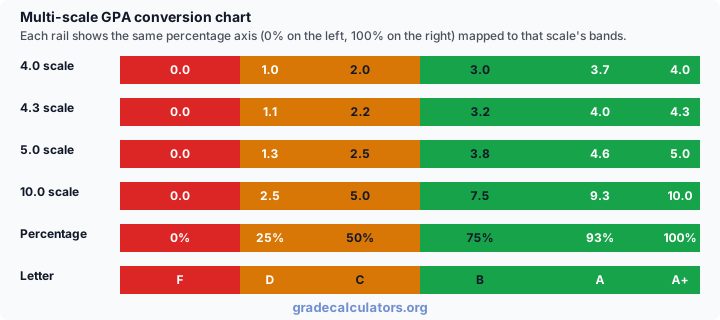
The conversion chart below maps a single percentage range across the 4.0, 4.3, 5.0, 10.0, and 12.0 scales plus letter grade. Use it as a quick-reference gpa conversion table when you don't need a calculation, just the band a value falls into.
Conversion Chart for GPA: Reading the Multi-Scale Table
The conversion chart for gpa below reads horizontally: pick the percentage band on the left, then read across to find the equivalent value on the 4.0, 4.3, 5.0, 10.0, or 12.0-point scale. The same row also shows the matching US letter grade. Read the chart vertically to convert in the opposite direction: a 3.7 in the 4.0 column corresponds to A- in the letter column and 90-92% in the percentage column. The flagship band-strip image above the chart visualizes the same data as parallel rails, useful for quick eyeballing without scanning rows.
| Percentage | 4.0 Scale | 4.3 Scale | 5.0 Scale | 10.0 Scale | Letter |
|---|---|---|---|---|---|
| 97-100% | 4.0* | 4.3 | 5.0 | 10.0 | A+ |
| 93-96% | 4.0 | 4.0 | 4.6 | 9.3 | A |
| 90-92% | 3.7 | 3.7 | 4.3 | 9.0 | A- |
| 87-89% | 3.3 | 3.3 | 3.8 | 8.5 | B+ |
| 83-86% | 3.0 | 3.0 | 3.5 | 8.0 | B |
| 80-82% | 2.7 | 2.7 | 3.1 | 7.5 | B- |
| 77-79% | 2.3 | 2.3 | 2.7 | 7.0 | C+ |
| 73-76% | 2.0 | 2.0 | 2.3 | 6.5 | C |
| 70-72% | 1.7 | 1.7 | 1.9 | 6.0 | C- |
| 67-69% | 1.3 | 1.3 | 1.5 | 5.5 | D+ |
| 63-66% | 1.0 | 1.0 | 1.1 | 5.0 | D |
| 60-62% | 0.7 | 0.7 | 0.8 | 4.5 | D- |
| Below 60% | 0.0 | 0.0 | 0.0 | 0.0 | F |
* A+ GPA = 4.0 at most US colleges; a minority award 4.3.
Grade to GPA Calculator: Letter and Percentage Inputs
The grade to gpa conversion path is the most-searched entry point in this cluster. Two cases cover the bulk of the queries: letter-grade input (A, A-, B+, etc.) and percentage input (88%, 92%, 76%). The converter above accepts both, but the underlying arithmetic differs. Letter-grade inputs map to fixed grade-point values (A = 4.0, A- = 3.7) via the 4.0 scale lookup table. Percentage inputs convert linearly: GPA = (Percentage / 100) x 4.0.
Number Grades to GPA: Percentage and Numeric Inputs
To convert number grades to gpa, divide the percentage by 25 (which is the same as the (% / 100) x 4.0 formula). An 88% becomes 88 / 25 = 3.52 on the 4.0 scale. The grades to gpa calculator path applies the same formula in single-value mode and weights by credits in course-rows mode. For pure numeric source values on a non-100 scale (Indian 10-point, Canadian 12-point), substitute the appropriate maximum into the cross-scale formula.
GPA Converter 100 to 4.0 Scale: The Percentage Path
The gpa converter 100 to 4.0 path is the most-searched conversion in this cluster. Direct linear formula: divide the percentage by 25 (because 100 / 4.0 = 25). A 100% maps to 4.0, an 87.5% maps to 3.5, a 75% maps to 3.0, a 50% maps to 2.0. Some US registrars use the band-table approach instead (97-100% = 4.0, 93-96% = 4.0, 90-92% = 3.7, etc.) which produces different results at the boundaries; the gpa calculator 100 to 4.0 mode in the converter above defaults to the linear formula and shows the band-table letter alongside.
GPA Conversion Calculator vs Reference Chart
A gpa conversion calculator runs the arithmetic per source value and is the right choice when your transcript has multiple courses to weight. A static gpa conversion table is faster when you only need one or two spot lookups and don't want to type. The page above ships both: the converter at the top for arithmetic, the chart and band-strip below for spot lookups. The same multi-scale data drives both, so the answers match.
Letter Grades to GPA Conversion
Letter grades to gpa conversion uses a fixed table: A and A+ both equal 4.0 on the standard scale, A- equals 3.7, B+ equals 3.3, and the 0.3 increment continues down through D- = 0.7 and F = 0.0. There's no interpolation between letter grades; each letter owns a single GPA value. To convert a transcript with mixed letter grades, look up each letter's GPA value, multiply by credit hours, sum the quality points, and divide by total credits.
Grades to GPA Calculator: When You Have Multiple Courses
Once you have more than two or three rows on a transcript, the grades to gpa calculator path beats hand arithmetic for accuracy. Switch the converter above to course rows mode and add one row per course; each row picks its own source scale (a single transcript can mix percentage entries with 4.0-scale entries with letter inputs). The calculator converts every row to the 4.0 scale, weights by credit hours, and shows the cumulative result on every common scale. The same gpa conversion table at the top of this page applies to every row's letter band as it computes.
Country-Specific GPA Conversions
Grading scales differ meaningfully across countries, and the linear formula above is a starting point rather than the final word. Each country sub-section below covers the most common conversion path plus the gotcha that catches students mid-application.
Canada GPA Converter: 12-Point Ontario and 4.3 McGill
The canada gpa converter path covers three Canadian provincial systems. Ontario institutions including the University of Toronto and McMaster use a 12-point scale where A+ = 12, A = 11, A- = 10, B+ = 9, and so on. Convert by dividing by 12 and multiplying by 4.0: an Ontario 9 (B+) becomes (9 / 12) x 4.0 = 3.0. McGill and a few other Quebec universities use a 4.3 scale similar to the US 4.3, with A+ = 4.3 above the standard A = 4.0. UBC and most Western Canadian universities use percentage transcripts, in which case the percentage formula applies. The canadian gpa converter mode in the widget above auto-runs whichever formula matches the source scale.
UK Grade to GPA: Honours Classification
UK universities classify degrees rather than reporting numeric GPAs. The standard mapping treats a First-class honours (70%+) as a 3.7 to 4.0 US GPA, an Upper Second (2:1, 60-69%) as 3.3 to 3.7, a Lower Second (2:2, 50-59%) as 2.7 to 3.3, a Third (40-49%) as 2.0 to 2.7, and a Pass below 40% as below 2.0. The uk grade to gpa conversion is approximate because UK marks distribute differently from US percentages; a 70% in a UK system is genuinely top-tier, not the 73% C the US scale would record. World Education Services publishes country-specific equivalency tables that admissions offices accept as authoritative.
India 10-Point CGPA Conversion
Indian universities use a 10-point CGPA reported alongside semester-level SGPAs. Convert directly with (CGPA / 10) x 4.0: an 8.5 CGPA equals 3.4 on the US 4.0 scale. The AICTE and many US graduate programs accept this linear conversion for self-reporting. The CBSE percentage formula (CGPA x 9.5 = percentage) is a separate calculation used at the secondary-school level; do not chain it with the 4.0 conversion. For a deeper Indian-specific treatment including SGPA-to-CGPA aggregation, see the dedicated CGPA-to-GPA converter linked in the related calculators below.
GPA Converter Italy, Germany, Netherlands, and France
Germany uses an inverse 1.0-5.0 scale where 1.0 is the top mark and 4.0 is the passing minimum; the linear formula in the converter above does not apply directly to inverse scales. To convert a German GPA, use the modified Bavarian formula: GPA(US 4.0) = 1 + 3 x (Source Max - Source GPA) / (Source Max - Source Min). The Netherlands uses a 1-10 scale where 6 is the passing minimum and 10 is rarely awarded; treat it as a direct linear conversion (Source / 10 x 4.0) and then verify with WES if the result is admissions-bound. France and Italy use 20-point scales where 16+ is excellent, 12-15 is good, and 10 is the passing minimum; convert via (Source / 20) x 4.0.
University GPA Converter and Admissions Recalculation
Most US universities recalculate GPA internally during admissions review. The figure on a transcript is rarely the figure an admissions officer sees on the application file. Universities apply their own conversion table that strips weighted bonuses, normalizes plus and minus modifiers, and re-weights per their own policy. This means the output of any university gpa converter, including this one, is a self-assessment tool rather than a binding figure.
When to Use a Credential Evaluator (WES, ECE, NACES)
Use a credential evaluator when the transcript is from outside the United States and the receiving institution requires a third-party equivalency. The wes gpa converter that World Education Services runs produces a course-by-course evaluation with a final US GPA equivalent that admissions offices treat as authoritative. WES, Educational Credential Evaluators (ECE), and other NACES-affiliated services charge fees ranging from about $100 to $200 per evaluation and take two to four weeks. For self-reporting on the Common App, a graduate-school CV, or a scholarship pre-screen, the linear formula and this converter are sufficient. For the official application file, the credential evaluator is mandatory at most institutions.
Weighted vs Unweighted GPA on Conversion
A common error is treating cross-scale conversion and weighted-vs-unweighted conversion as the same operation. They are not. Cross-scale conversion changes the maximum (4.0 to 5.0, 5.0 to 4.0); weighted-vs-unweighted conversion strips or adds the AP/Honors bonus point. A 4.5 weighted GPA on the 5.0 scale is not directly comparable to a 4.5 on a different 5.0 scale; the underlying course rigor matters. To convert a weighted GPA cleanly, drop the bonus first (subtract +1.0 for AP courses, +0.5 for Honors per US convention), get the unweighted figure, then run the cross-scale formula. The converter above treats every input as already-normalized for the chosen scale; if your source value is weighted, decide whether you want the weighted or unweighted equivalent before entering it.
Linear vs Grade-Point-Mapping Methods
Two methods exist for converting between numeric and band-based scales (the most common case being percentage to 4.0). The linear method applies the formula GPA = (Percentage / 100) x 4.0, treating the relationship as proportional across the full range. The band-table method maps percentage ranges directly to fixed 4.0 values: 97-100% = 4.0, 93-96% = 4.0, 90-92% = 3.7, 87-89% = 3.3, and so on through the 0.3 increments down to F.
The linear method gives a smooth conversion with decimals: 88% becomes 3.52, 91% becomes 3.64, 95% becomes 3.80. The band-table method gives the value a US registrar would record on a transcript: 88% rounds to 3.3 (B+), 91% rounds to 3.7 (A-), 95% rounds to 4.0 (A). For self-assessment and applications where you are reporting the figure yourself, linear is acceptable. For matching what an admissions committee sees when they recalculate, band-table is closer to reality. The converter above defaults to linear for percentage input; the conversion chart further up the page shows the band-table values side by side.
Edge Cases that Affect Cross-Scale GPA Conversion
Several transcript entries fall outside the standard letter-to-grade-point conversion and need special handling before the converter produces a number that matches your registrar's official figure.
- Pass/Fail (P/NP) and Pass/No-Credit (S/NC): excluded from the GPA calculation entirely on most US scales. Credits earned still count toward graduation; grade points don't. Skip these courses when calculating the source GPA, then run the conversion on the remaining graded courses only.
- Withdrawals (W) and withdraw-fail (WF): a W usually carries no GPA impact at most US institutions; WF often counts as F at schools that distinguish the two. Confirm the policy with your registrar before including a row.
- Incompletes (I) and in-progress courses: not included in the GPA calculation until a final letter grade is submitted. Once the I converts to a letter grade, enter it normally.
- Retaken courses: grade-replacement policies vary widely. Some schools replace the original grade with the retake; others average both attempts; others count both for credit but only the higher grade for GPA. Verify your registrar's repeat-course policy before running the conversion.
- Transfer credits: credits typically transfer toward the degree; grades typically don't transfer into the institutional GPA at the receiving school under standard AACRAO conventions. Convert the transfer GPA separately if you need a self-assessed cumulative figure.
Latin Honors After Conversion
Once you have your converted 4.0-scale GPA, the typical Latin honors thresholds at US universities are Cum Laude at 3.5, Magna Cum Laude at 3.7, and Summa Cum Laude at 3.9. Some schools cap honors at the top 10% of the graduating class regardless of absolute GPA, and a minority use a 4.33 scale where the thresholds shift slightly upward. Check your university registrar page for the exact cutoffs before using a converted figure to estimate honors eligibility.
Sources: AACRAO grading and transcript standards; World Education Services country resources; College Board grade conversion guidance. Always verify the final figure with your target school's registrar; conversion policies vary by institution. Last verified: May 2026.
For other related calculations: use the GPA calculator to compute a 4.0-scale GPA from a fresh transcript, the GPA to percentage converter to map a 4.0 GPA back to a percentage, the GPA to letter grade chart to map any GPA value to a single letter, and the CGPA to GPA converter for the dedicated Indian and South Asian 10-point CGPA path.