| Course | Grade | Credits | Remove |
|---|---|---|---|
Enter your current cumulative GPA from your transcript, how many GPA-applicable credits you have completed, your projected semester GPA from Mode 1, and the credits you are taking this term.
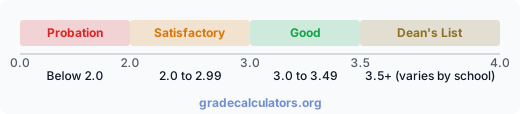
GPA scale: Probation / Good Standing / Dean's List
Add courses above to calculate your semester GPA.
Letter Grade to GPA Points Reference (4.0 Scale)
| Letter | GPA Points | Percentage |
|---|---|---|
| A+ | 4.0* | 97-100% |
| A | 4.0 | 93-96% |
| A- | 3.7 | 90-92% |
| B+ | 3.3 | 87-89% |
| B | 3.0 | 83-86% |
| B- | 2.7 | 80-82% |
| C+ | 2.3 | 77-79% |
| C | 2.0 | 73-76% |
| C- | 1.7 | 70-72% |
| D | 1.0 | 60-69% |
| F | 0.0 | Below 60% |
* A+ and A both map to 4.0 on the standard scale at most US colleges. A minority of schools award A+ = 4.3. Verify with your registrar.
How to Calculate Semester GPA: The Formula
A semester GPA is a credit-weighted average. You can't simply average the letter grades because courses carry different credit values. A four-credit organic chemistry course pulls twice the weight of a two-credit lab. The registrar's formula accounts for this by converting each grade to a numeric value, scaling it by credits, and dividing the sum by total credits attempted.
Calculate semester GPA step by step
- List every graded course in the semester with its credit hours.
- Convert each letter grade to grade points on the 4.0 scale (see the reference table in the calculator above).
- Multiply grade points by credit hours for each course to get quality points.
- Sum all quality points.
- Divide the total quality points by the total credit hours attempted. That result is your semester GPA.
- Grade Points = numeric value of the letter grade on the 4.0 scale (A = 4.0, B+ = 3.3, C = 2.0, etc.)
- Credits = credit hours assigned to that course
- Quality Points = Grade Points x Credits for one course
Calculate semester GPA from percentage scores
Switch the calculator to Percentage mode if your professor posts scores as numbers. The standard conversion maps 93-100 to A (4.0), 90-92 to A- (3.7), 87-89 to B+ (3.3), 83-86 to B (3.0), 80-82 to B- (2.7), 77-79 to C+ (2.3), 73-76 to C (2.0), 70-72 to C- (1.7), 60-69 to D (1.0), and 0-59 to F (0.0). These thresholds reflect the most common US college grading scale. Individual professors can set slightly different cutoffs in their syllabi, so treat the converted grade as an estimate when the official letter grade hasn't posted yet.
Semester GPA vs Cumulative GPA: What Each Number Covers
Students often see two GPA figures on the same transcript and aren't sure which one to report on an application. The short version: semester GPA is for tracking your own performance each term. Cumulative GPA is for everything external.
| Attribute | Semester GPA | Cumulative GPA |
|---|---|---|
| Time period covered | One academic term | All terms to date |
| Use case | Dean's List, academic standing review, self-tracking | Graduate applications, job applications, scholarships |
| Courses included | Current semester only | Every graded course on transcript |
| Effect of one bad grade | High impact (fewer credits absorb the drag) | Lower impact (larger credit base dilutes it) |
| How to calculate | Quality points this term / credits this term | Total quality points all terms / total credits all terms |
Term GPA at semester versus quarter schools
Semester schools run two main terms per year, each about 15 to 16 weeks. Quarter schools run three terms per year, each about 10 weeks. The GPA formula is the same for both: quality points divided by credits attempted in that term. Quarter GPA is sometimes labeled "term GPA" on the transcript. This calculator works for semesters, quarters, and trimesters. Enter the credit values your school uses and the result is correct regardless of term length.
GPA for the Semester: Academic Standing Thresholds
Three benchmarks matter most in undergraduate academic standing. The specific cutoffs vary by institution, but the ranges below reflect what most US colleges publish in their academic policies.
| Semester GPA | Academic Standing | What It Typically Means |
|---|---|---|
| 3.7 to 4.0 | Dean's List (most four-year schools) | Honors recognition; often requires minimum 12 credit hours that term |
| 3.5 to 3.69 | Dean's List (some schools; check your registrar) | Some institutions set the bar at 3.5; community colleges often use this threshold |
| 2.0 to 3.49 | Good Standing | Meets minimum graduation requirements and federal financial aid SAP rules |
| Below 2.0 | Academic Probation | Risk of dismissal; financial aid suspension may follow under federal SAP rules |
What GPA is needed for Dean's List?
The most common Dean's List threshold is a semester GPA of 3.5 with at least 12 credit hours completed that term. At research universities and selective liberal arts colleges, the bar is often 3.7 or the top 10 to 15 percent of enrolled students by GPA for that semester. Some schools use a tiered system: a President's List at 4.0 and a Dean's List at 3.5 to 3.99. Confirm the exact criterion on your registrar's academic honors page. Source: National Association for College Admission Counseling (NACAC).
How Credit Hours Shape Your Semester GPA
Credit hours are the weights in the GPA formula. A four-credit course has four times the influence of a one-credit course with the same letter grade. This asymmetry creates a planning opportunity that most students overlook.
A student taking 15 credits (four three-credit lectures and one three-credit lab) who earns A grades in the lectures but a C in the lab gets (4.0 x 3 + 4.0 x 3 + 4.0 x 3 + 4.0 x 3 + 2.0 x 3) / 15 = 54 / 15 = 3.60. If that same lab were only 1 credit instead of 3, the result would be (48 + 2) / 13 = 3.85. The credit load on the weak course matters as much as the grade itself.
Calculate semester GPA with different credit configurations
Engineering, nursing, and STEM programs often include four-credit courses with embedded labs. Medical school prerequisites frequently carry four or five credits. Some online programs use half-credit courses. The calculator accepts any credit value from 0.5 to 12 per row, so compressed intensive courses, half-semester modules, and variable-credit seminars all work without adjustment. Just enter the credit value from your registration confirmation or course catalog.
GPA Calculator for Semester Grades: Grade Types and Exceptions
Not every course entry on your transcript feeds into the semester GPA formula. Several grade types are excluded, and misidentifying them is the most common source of manual calculation errors.
- Pass/Fail (P/NP, S/NC): excluded from the GPA calculation at most schools. Credits earned still count toward graduation requirements. Omit these rows or set credits to zero when using the calculator.
- Withdrawals (W): no GPA impact at most US institutions. A withdrawal does reduce your completion rate, which matters for federal financial aid Satisfactory Academic Progress (SAP). A late-withdrawal that converts to WF counts as an F; confirm the deadline and conversion policy with your registrar.
- Incompletes (I): not included until the final grade is submitted. Once the I converts to a letter grade, enter it normally. If it converts to F by default past the deadline, enter F.
- Retaken courses: grade-replacement policies vary. Some schools replace the original grade; others average both attempts; others count both for GPA. Check your registrar's repeat-course policy before entering retake data.
- Transfer credits: typically count toward your degree but do not enter your institutional GPA at the receiving school under standard AACRAO conventions. Begin your receiving-school GPA from zero even if your sending transcript shows a different number.
- Audited courses (AU): not graded, not credit-bearing. Always exclude from GPA input.
GPA by Semester Calculator: Projecting Your Cumulative GPA
Use Mode 2 (New Cumulative GPA) in the calculator above to model where your cumulative average will land after this semester. The formula is:
- Current GPA = your cumulative GPA before this semester (from your transcript)
- Current Credits = total GPA-applicable credits completed before this semester
- Semester GPA = your result from Mode 1, or a target GPA you are planning toward
- New Credits = credit hours you are taking this semester
A student finishing their second year with a 2.8 cumulative GPA over 60 credits who earns a 3.5 semester over 15 new credits projects to (168 + 52.5) / 75 = 2.94 cumulative. That same student needs roughly four consecutive semesters at 3.5 to clear a 3.0 cumulative threshold. The raise GPA calculator models the exact number of semesters needed to reach any target from any starting point.
To track GPA over multiple terms without re-entering every course, use the cumulative GPA calculator. It accepts a prior GPA and credits as a seed, then adds new semester data on top.
Calculate GPA After This Semester: Common Scenarios
Two scenarios come up most often when students want to calculate my GPA after this semester.
Scenario 1: Will I make Dean's List this semester? A student taking 15 credits needs every course to average above the Dean's List threshold. If four courses are A grades (4.0 x 3 each) and one course is a B+ (3.3 x 3), semester GPA = (12 + 12 + 12 + 12 + 9.9) / 15 = 57.9 / 15 = 3.86. That clears most Dean's List thresholds. Had one of those A grades been a B (3.0 x 3 = 9), the result would drop to (12 + 12 + 12 + 9 + 9.9) / 15 = 54.9 / 15 = 3.66, which still qualifies at schools with a 3.5 cutoff but misses those requiring 3.7.
Scenario 2: How much can one semester move my cumulative GPA? Early in college, a lot. A first-semester student with no prior credits earns a 3.4 semester GPA: that is their cumulative GPA. After 30 credits at 3.4, one 15-credit semester at 3.8 raises cumulative to (102 + 57) / 45 = 3.53. After 90 credits at 3.4, the same semester produces only (306 + 57) / 105 = 3.46. The denominator is the limiting factor. Enter your specific numbers into Mode 2 above to see the exact projection for your situation.
Related GPA Calculators
The semester GPA calculator handles one term at a time. For related questions, these tools handle the next step:
- GPA Calculator: the standard 4.0-scale GPA calculator; works for any transcript length
- Cumulative GPA Calculator: tracks running total across all semesters with a prior-GPA seed
- College GPA Calculator: undergraduate GPA including Dean's List and honors society thresholds
- Weighted Grade Calculator: adds AP, IB, and Honors bonus points for high school transcripts
GPA calculations on this page use the standard 4.0 unweighted scale. Always verify your official GPA with your college registrar. Grading policies and GPA scales vary by institution. Last verified: May 2026.