GPA calculator with pass/fail course support
| Course | Credits | Grade | Remove |
|---|
| Course | Credits | Result | Remove |
|---|
Letter grade reference and P/F GPA rules
| Letter | Points | Range | P/F rule |
|---|---|---|---|
| A+ | 4.0* | 97-100% | P: excluded from GPA |
| A | 4.0 | 93-96% | P: excluded from GPA |
| A- | 3.7 | 90-92% | P: excluded from GPA |
| B+ | 3.3 | 87-89% | P: excluded from GPA |
| B | 3.0 | 83-86% | P: excluded from GPA |
| B- | 2.7 | 80-82% | P: excluded from GPA |
| C+ | 2.3 | 77-79% | P: excluded from GPA |
| C | 2.0 | 73-76% | P: excluded from GPA |
| C- | 1.7 | 70-72% | P: excluded from GPA |
| D | 1.0 | 60-69% | P: excluded from GPA |
| F | 0.0 | Below 60% | F: 0.0, credits in denominator |
* A+ = 4.0 at most US colleges; a minority award 4.3. Pass grades are excluded from GPA entirely. Fail grades on a P/F election count the same as a standard F for GPA purposes.
How Pass/Fail Courses Affect Your GPA Calculation
Pass/fail grading follows a strict asymmetry that most students don't fully understand until they see the math. A passing grade (P) is genuinely neutral: the credit hours appear on your transcript and count toward the total credits for graduation, but the course drops out of the GPA formula entirely. Neither the numerator nor the denominator of the GPA fraction changes. Your cumulative GPA after taking a P course is identical to what it would have been if that course never existed.
A failing grade on a pass/fail election works differently. An F (or NP, depending on your school's terminology) contributes zero quality points to the numerator AND keeps the credit hours in the denominator. That is the same GPA impact as a standard F. Students sometimes assume that because they "took it pass/fail," a failing result won't matter as much. It does. This is the most important thing to understand before electing pass/fail in any course you're not confident you can pass.
The GPA Formula with Pass/Fail Courses
- Grade Points = numeric value on 4.0 scale for letter-graded courses (A = 4.0, B = 3.0, etc.)
- Graded credits = credits from courses with a letter grade (A through F)
- F-outcome P/F credits = credits from pass/fail courses where the result was Fail (0.0 quality points)
- P-outcome credits = excluded entirely from the GPA formula (counted only toward graduation)
P vs. F on a Pass/Fail Election: GPA Impact Side by Side
| Outcome | Quality points added | Credits in GPA denominator | Credits toward graduation | Net GPA effect |
|---|---|---|---|---|
| P (Pass) | 0 | No | Yes | None (excluded entirely) |
| F (Fail / NP) | 0 | Yes | No | Lowers GPA (same as letter-grade F) |
Source: AACRAO registrar standards for P/F grade treatment, consistent with standard US registrar practice documented by NCES grading data. Always verify the specific policy with your institution's registrar before electing pass/fail.
When to Elect Pass/Fail: A Practical Decision Guide
The math gives you a clear decision rule. If you project a grade lower than your current cumulative GPA, taking the course pass/fail protects your average by removing it from the calculation. If you project a grade higher than your current GPA, taking it for a letter grade pulls the average up. The break-even point is your current GPA: a projected grade equal to your GPA average has no impact either way.
That rule works cleanly for elective courses. It breaks down immediately for major requirements, prerequisites with a grade floor, and courses relevant to professional school applications.
Pass/Fail Restrictions at Most US Universities
| Restriction | Typical policy | Why it matters |
|---|---|---|
| Major requirements | P/F election not allowed for required major courses | Departments need a graded record for academic review and graduate school recommendation letters |
| Prerequisites with grade floors | P does not satisfy a "C or better" prerequisite | Downstream courses may require a verified minimum grade, which a P does not confirm |
| Credit cap | Maximum 1 course per semester or 8 to 16 total P/F credits | Prevents students from converting entire semesters to pass/fail |
| Election deadline | Must elect within first 3 to 5 weeks of the term | Prevents students from switching after seeing midterm grades |
| Graduate school applications | AMCAS and LSAC may recalculate using the actual grade rather than P | Science prerequisites especially: elect letter grade when applying to medical or law school |
Credit/No Credit vs. Satisfactory/Unsatisfactory vs. Pass/Fail
US schools use several names for the same concept: Pass/Fail (P/F), Credit/No Credit (CR/NC), Satisfactory/Unsatisfactory (S/U), and Pass/No Pass (P/NP) all refer to the same grading mode where a student earns credit without a letter grade. The GPA treatment is almost always identical: the passing variant (P, CR, S) is excluded from GPA; the failing variant (F, NC, U, NP) is included as 0.0. The threshold for passing also varies by school: some set it at 60% (standard D), others at 70% (C-), and some at 73% or 75%. Check your academic handbook for the exact threshold before relying on a projected grade near the passing line.
Pass/Fail and Graduate School Applications
Medical, law, and other professional programs each handle pass/fail grades differently on their standardized application platforms. Understanding these rules before electing pass/fail in a prerequisite course can save significant GPA damage during the admissions recalculation.
- AMCAS (medical school): The American Medical College Application Service recalculates GPA using any available grade data. If your school uses P/NP but also records the underlying grade for students who elected pass/fail, AMCAS may use the underlying grade. For prerequisite science courses, a letter grade is almost always safer.
- LSAC (law school): The Law School Admission Council typically excludes P/F courses from GPA calculation when the transcript clearly marks them as pass/fail. However, excessive pass/fail elections can look like GPA management to admissions readers.
- Graduate programs (MS, PhD, MBA): Most programs prefer letter grades in prerequisite coursework. P/F in free electives is generally viewed neutrally. Check the specific admissions requirements for each program before electing pass/fail in any course that might appear on a statement of purpose or recommendation letter.
- NCAA eligibility: The NCAA Eligibility Center assigns the lowest passing grade-point equivalent when a P grade appears in a required core course. A P that earned an A performance gets mapped to a 1.0 (D), not a 4.0, for eligibility calculation purposes.
GPA Calculation Examples with Mixed Graded and P/F Courses
Two scenarios illustrate the calculator's output for a typical semester with both graded and pass/fail courses.
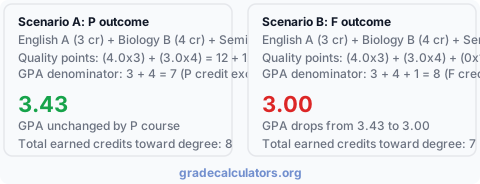
How P/F Credits Dilute GPA at Higher Credit Loads
A subtlety some students miss: even a passing P grade has an indirect effect on GPA when measured against total credits attempted rather than GPA credits. If you take 18 credits but 3 are P/F passes, your GPA reflects only 15 credits of performance. A strong semester in the other 15 credits looks less impressive on a per-credit-attempted basis. Some scholarship committees and honors programs look at total credits attempted, not just GPA credits, when evaluating academic load. Ask your honors advisor which denominator your program uses before loading up on P/F elections in an otherwise strong semester.
For tracking your cumulative GPA across multiple semesters, use the cumulative GPA calculator. To compute GPA on a full mix of letter-graded courses without any P/F component, use the standard GPA calculator. If you're planning to drop a course rather than take it pass/fail, the drop class GPA calculator shows how a withdrawal affects your current GPA. For projecting the GPA impact of your entire course plan, the college GPA calculator handles multi-semester cumulative tracking.
Last verified: May 2026. Pass/fail GPA treatment follows AACRAO registrar standards and NCES grading data. Always confirm your specific institution's pass/fail policy with your registrar before making enrollment decisions.